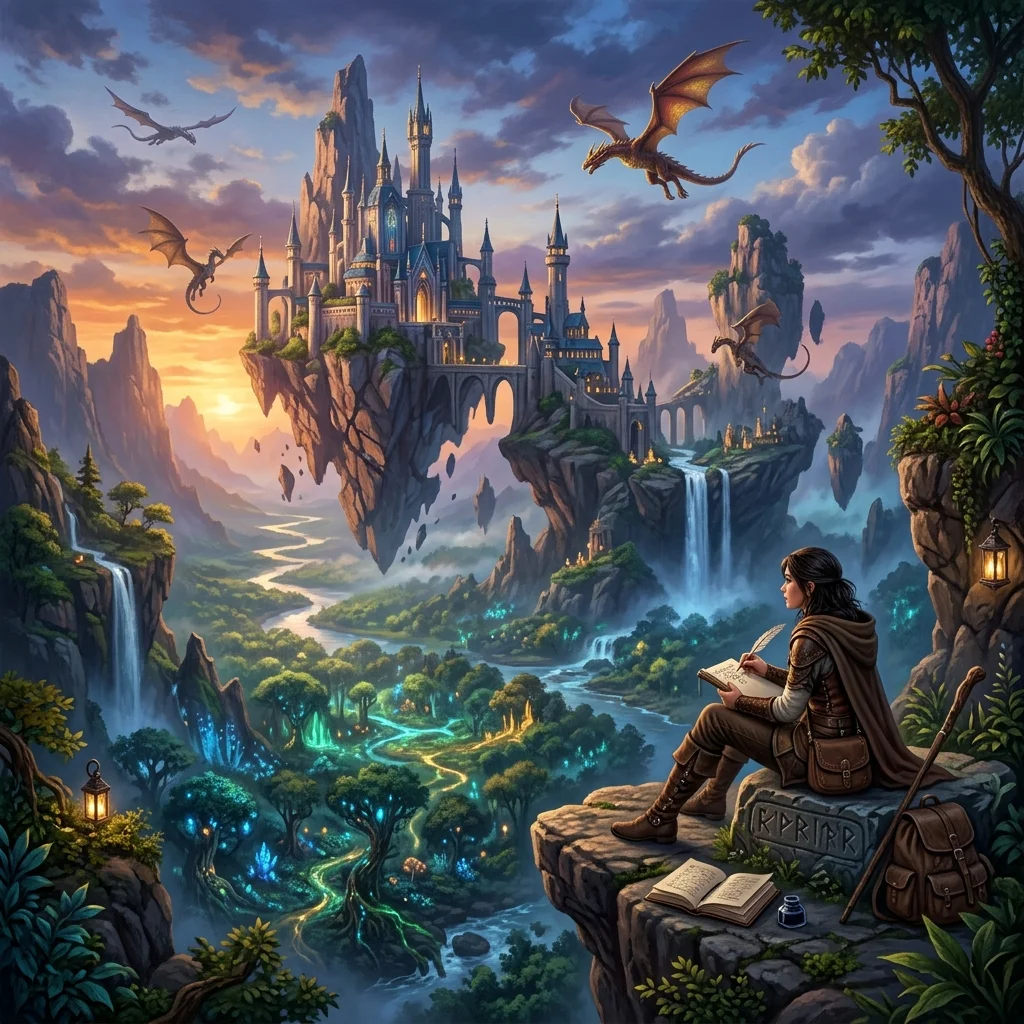
175+ Fantasy Writing Prompts: Magical Ideas to Spark Your Imagination (2026 Guide)
175+ Fantasy Writing Prompts: Magical Ideas to Spark Your Imagination (2026 Guide)
Introduction
Every great fantasy story begins with a single spark of imagination. Maybe it's a what-if question that won't leave your mind. Perhaps it's a vivid dream of a world where magic flows like rivers and ancient creatures guard forgotten secrets. Or maybe you're staring at a blank page, knowing you want to write fantasy but unsure where to begin.
That's where fantasy writing prompts come in.
Whether you're a seasoned fantasy author looking to break through writer's block, a student discovering the joy of worldbuilding, or a complete beginner who's always dreamed of creating your own magical realm, the right prompt can unlock doors you didn't even know existed in your imagination.
In this comprehensive guide, we're going to explore over 175 fantasy writing prompts designed to ignite your creativity and help you craft stories that transport readers to worlds they've never imagined. We'll cover everything from classic tropes like dragons, wizards, and enchanted castles to fresh, innovative concepts that will make your stories stand out in a crowded genre.
But this isn't just a list. We're going to dive deep into why fantasy prompts work, how to use them effectively, the benefits they offer writers at every level, and the common mistakes that can turn a promising fantasy concept into a cliché-ridden mess. We'll also explore tips for writing better fantasy, how to develop your own unique voice in the genre, and strategies for turning a simple prompt into a fully realized story.
By the time you finish this guide, you won't just have a massive collection of fantasy story prompts at your fingertips. You'll understand how to use them to grow as a writer, how to avoid the pitfalls that trap inexperienced fantasy authors, and how to create fantasy worlds that feel as real to your readers as the world outside their window.
So grab your quill—or your laptop—and let's step through the portal into the realm of unlimited imagination.
A creative environment helps writers build immersive fantasy worlds.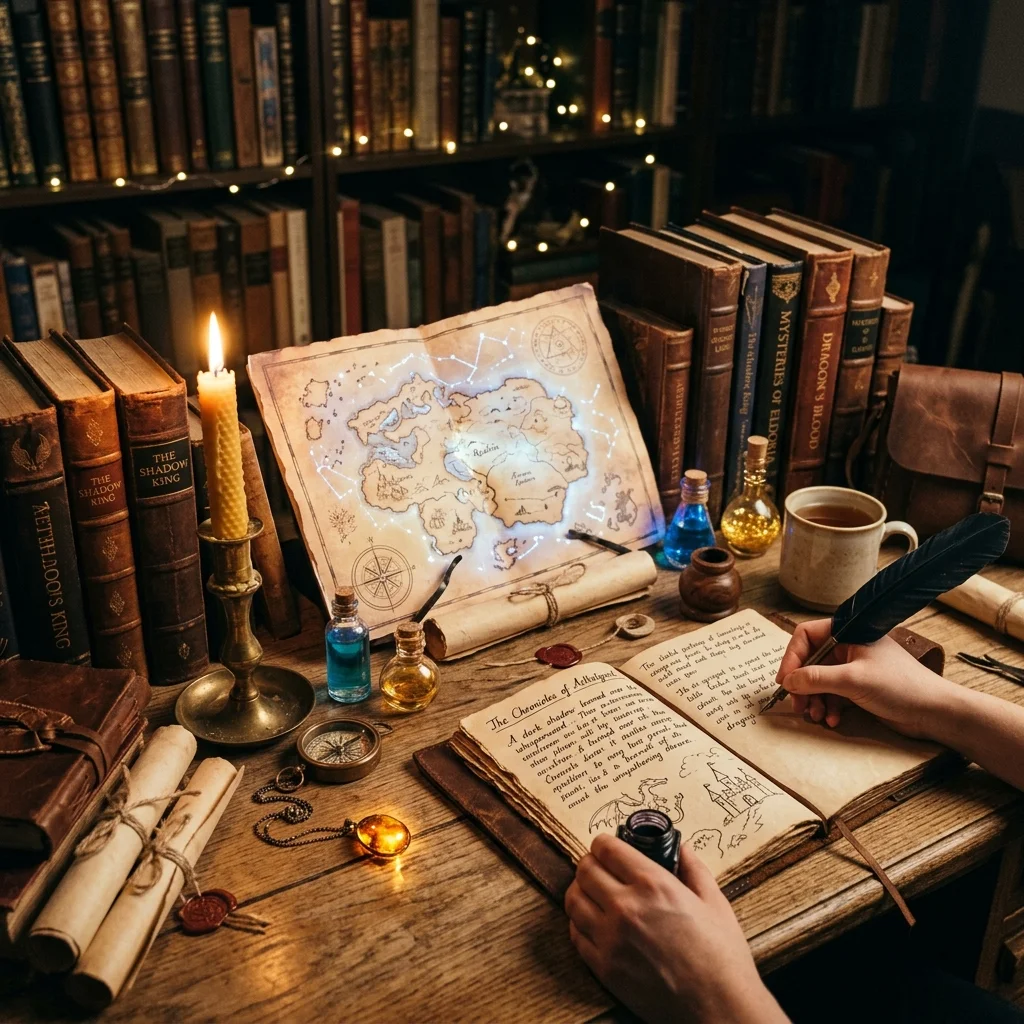
Section 1: What Are Fantasy Writing Prompts?
Before we unleash the horde of prompts waiting in the sections ahead, let's establish what fantasy writing prompts actually are and why they're such powerful tools for writers.
The Definition
At their simplest, fantasy writing prompts are story starters, scenarios, questions, or concepts that provide a jumping-off point for fantasy stories. They might be a single sentence ("You discover you can breathe underwater, but only when you're telling the truth"), a detailed scenario ("A wizard's apprenticeship exam requires stealing something from a dragon's hoard—without the dragon noticing"), or even just a word or phrase ("The last unicorn").
Fantasy prompts differ from prompts in other genres because they explicitly invite the impossible. While a romance prompt might ask you to write about two people meeting in an unexpected place, a fantasy prompt might ask you to write about two people meeting in a place that doesn't exist—and make the reader believe in it completely.
Why Fantasy Prompts Work
Fantasy is a genre built on asking "what if?" What if magic was real? What if humans weren't the dominant species? What if the stars were actually the eyes of ancient gods watching us? Fantasy writing prompts channel that same spirit of inquiry and give it direction.
The best fantasy story prompts don't just provide a cool concept—they create tension, raise questions, and imply conflict. A prompt like "Write about a wizard" is too vague to be useful. But "Write about a wizard who's losing their magic, one spell at a time, and the desperate things they do to hold onto the last one" creates immediate stakes and character motivation.
Types of Fantasy Prompts
Fantasy prompts come in many flavors, and different types work better for different writers and different stages of the writing process. Here are the main categories:
Scenario Prompts: These present a situation and ask you to explore what happens. "You wake up with wings" is a scenario prompt.
Character Prompts: These give you a character concept and invite you to tell their story. "A blacksmith who can forge weapons that absorb magic" is a character prompt.
Worldbuilding Prompts: These focus on the setting. "A city built entirely on the backs of sleeping giants" is a worldbuilding prompt.
Object Prompts: These center on a magical item. "A mirror that shows not your reflection, but your past lives" is an object prompt.
Question Prompts: These pose a question that the story must answer. "What if the monsters under the bed are actually protecting children from something worse?" is a question prompt.
Understanding these types helps you choose prompts that align with your strengths as a writer. If you love character development, gravitate toward character prompts. If you're a worldbuilding nerd, look for prompts that let you create settings.
Section 2: Benefits of Using Fantasy Writing Prompts
You might be wondering: why not just start with a blank page and see what happens? Why use prompts at all? The answer lies in the unique benefits that fantasy writing prompts offer, particularly for this genre.
Overcoming the Blank Page Paralysis
Every writer knows the terror of the blank page. That cursor blinking accusingly, daring you to be brilliant. Fantasy writing prompts eliminate that paralysis by giving you a starting point. You don't have to invent everything from nothing. The prompt provides the seed, and your imagination provides the growth.
For beginning writers especially, fantasy prompts lower the barrier to entry. You don't need to have a fully realized world, a magic system, and a cast of characters figured out before you start writing. The prompt gives you enough to begin, and the rest emerges as you write.
Breaking Out of Creative Ruts
Even experienced writers fall into patterns. Maybe you always write the same type of protagonist, or your magic systems all work basically the same way, or you keep returning to the same subgenre. Fantasy writing exercises in the form of unusual or challenging prompts can force you out of those ruts.
A prompt that asks you to write about a world where magic is a disease, or where the hero is a bureaucrat rather than a warrior, pushes you into unfamiliar territory. That's where growth happens.
Practicing Specific Skills
Different fantasy prompts let you practice different aspects of the craft. A prompt focused on a magical heist lets you practice plotting and pacing. A prompt about a diplomatic meeting between species lets you practice dialogue and worldbuilding. A prompt about a character discovering their powers lets you practice emotional depth and character arc.
By intentionally choosing prompts that target your weak areas, you can use fantasy writing prompts as targeted practice tools, almost like scales for a musician.
Generating Ideas for Larger Projects
Sometimes a prompt doesn't just inspire a short story—it becomes the seed for a novel, a series, or an entire fictional world. Many published fantasy authors started with a simple prompt or writing exercise that unlocked something they didn't know was there.
The beauty of fantasy is that the genre has such breadth and depth that a single prompt can expand in countless directions. "Write about a kingdom where magic is currency" could become a heist story, a political thriller, a romance, or an epic fantasy trilogy depending on how you develop it.
Building Consistency and Habit
Writing regularly is hard. We all know we should do it, but life gets in the way, motivation fluctuates, and suddenly it's been three weeks since you opened your manuscript. Fantasy creative writing prompts make it easier to maintain a writing habit because they remove the "what should I write today?" decision fatigue.
If you commit to writing to one prompt per day, or three prompts per week, you always know what you're supposed to be working on. That clarity makes it easier to sit down and actually write.
Section 3: How to Use Fantasy Writing Prompts Effectively
Having a list of prompts is like having a spice rack. It's useful, but you need to know how to cook to make something delicious. Here's how to get the most out of fantasy writing prompts.
Don't Feel Bound by the Prompt
The most important thing to understand about fantasy prompts is that they're suggestions, not commandments. If a prompt says "Write about a dragon who collects clocks," but as you start writing you realize the story really wants to be about a dragon who collects memories, that's fine. Let the prompt be a starting point, not a cage.
Some of the best stories come from writers who took a prompt in a completely unexpected direction. The prompt's job is to get you writing, not to dictate every aspect of the story.
Combine Prompts for Complexity
One prompt can give you a character. Another can give you a setting. A third can give you a conflict. Put them together, and you have a story with depth and originality. Don't be afraid to mash up multiple fantasy story ideas to create something uniquely yours.
For example, combine "A wizard who's afraid of magic" with "A kingdom where magic is forbidden" and "A theft that could start a war," and you have the beginning of a complex, layered story that none of those prompts could create on their own.
Use Prompts for Warm-Up Writing
Before you dive into your main work-in-progress, spend ten minutes freewriting to a fantasy prompt. This gets your creative muscles warmed up, helps you transition into writing mode, and can sometimes generate ideas or insights that improve your main project.
Many professional writers use prompts as part of their daily routine, not to create finished stories, but to maintain a creative flow that carries into their more serious work.
Set Constraints to Boost Creativity
Sometimes, the more limitations a prompt gives you, the more creative you have to be. If a prompt says "Write a fantasy story without using the word 'magic'," you have to find creative ways to convey the supernatural elements of your world. These constraints force you to dig deeper and find more original solutions.
Similarly, give yourself format constraints. Can you respond to a prompt in the form of a series of letters? A diary entry? A trial transcript? Experimenting with format makes the exercise more challenging and more educational.
Write the Same Prompt Multiple Times
This is an advanced exercise, but a powerful one. Take a single prompt and write it as a flash fiction piece, then as a poem, then as a dialogue-only scene, then as a description-heavy narrative. Each version will teach you something different about craft and about the prompt itself.
You can also write the same prompt at different points in your writing journey and see how your skills and interests have evolved.
Section 4: 175+ Fantasy Writing Prompts by Category
Now for the heart of this guide: the prompts themselves. I've organized them into categories so you can easily find prompts that match what you're in the mood to write. Remember, these are starting points. Change the gender, the setting, the magic system, whatever you need to make the story yours.
Magic and Spellcasting Prompts
You discover that your shadow has been casting spells when you're not looking, and they're not always benevolent ones.
In this world, magic requires a sacrifice. What will your protagonist give up to save someone they love?
Write about a magic school where the students keep failing their final exam because the magic itself is testing them in ways the teachers didn't anticipate.
A spell goes wrong and now your protagonist can only speak in riddles. How do they navigate a crisis when they can't communicate directly?
Magic is transmitted like a disease. Your protagonist has just started showing symptoms.
You find an old spellbook where the previous owner crossed out all the offensive spells and wrote recipes in the margins instead.
In a world where magic is illegal, your protagonist is the only one who can still cast spells—but they don't know why.
Write about a magical contract where the fine print is literally written in starlight, and only visible during specific astronomical events.
Your magic works perfectly, except it always manifests in the wrong emotional moment. You cast fireballs when you're happy and healing spells when you're angry.
A wizard's staff is stolen, but the staff has developed a personality of its own and keeps escaping from its new owner.
Magic requires names. Your protagonist is a namer, someone who can give true names to things—including concepts like "fear" and "love."
Write about a world where magic is tied to music, and the last magical musician is going deaf.
You can cast any spell, but only if you can draw the sigil backwards in the air with your non-dominant hand while standing on one foot.
In this kingdom, magic is auctioned to the highest bidder. Your protagonist is a magical item up for sale.
Write about a spell that was cast so long ago its original purpose has been forgotten, but its effects are still shaping the present.
Writing Tip: When working with magic prompts, spend time thinking about the costs and limitations of magic in your world. Magic without rules or consequences quickly becomes boring to readers. The most interesting magical conflicts come from magic that creates as many problems as it solves.
Dragons and Mythical Beasts Prompts
The last dragon isn't fire-breathing or fearsome. It's tiny, it's fluffy, and it cries whenever anyone tries to be heroic around it.
Write about a dragon who's decided to go on strike. No more guarding treasures, no more maiden kidnapping. It wants a career change.
In this world, dragons are endangered, and your protagonist is a dragon conservationist trying to protect the last breeding pair.
You're not supposed to be able to communicate with dragons, but you just heard one ordering a pizza.
A dragon's hoard isn't gold and jewels. It's something deeply personal to the dragon's nature. What does your dragon collect?
Write about a world where dragons are the size of cats and are kept as pets by the nobility, but they're still deadly if provoked.
The dragon your protagonist is supposed to slay is weeping. It won't say why, but it clearly needs help, not a hero's sword.
In a twist on the genre, dragons are the protagonists, and humans are the terrifying monsters in their stories.
Your dragon companion has just informed you that they're not actually a dragon—they've been polymorphed, and they're about to change back.
Write about a dragon who's the world's most reluctant mentor figure. They've been assigned to teach a hero, and they absolutely do not want to be there.
Dragon eggs are hatching all over the city, and nobody knows why. Your protagonist is the only one who seems to be able to communicate with the hatchlings.
In this world, dragon fire doesn't burn—it freezes. Your protagonist has to rethink everything they know about dragon lore.
A dragon has been terrorizing the countryside, but when your protagonist finally confronts it, they realize the dragon is just lonely.
Write about the last battle between dragons and humans from the perspective of the dragon commander.
Your protagonist discovers they can ride dragons, but there's a catch—the dragon has to agree to carry them, and dragons are notoriously stubborn.
Writing Tip: Dragon stories work best when the dragon feels like a fully realized character, not just a monster or a mount. Give your dragon opinions, preferences, fears, and desires. Even if the dragon can't speak, show their personality through actions and reactions.
Fantasy prompts inspire students to think creatively and improve storytelling skills.
Wizards, Witches, and Sorcerers Prompts
Your protagonist is a wizard who's terrible at magic but exceptional at everything else. How do they navigate a world that expects them to be powerful?
Write about a witch who runs an advice column for other supernatural beings.
In this world, wizards don't cast spells. They negotiate with spirits, and the spirits are notorious tricksters.
The most powerful wizard in the kingdom has just been outed as a complete fraud who's been using stage magic and illusions. Your protagonist knows the truth and has to decide whether to expose them.
Write about a magical apprenticeship where the master is never seen, and all instructions come through increasingly cryptic notes.
A sorcerer's power comes from their hair. As they use magic, their hair turns gray and falls out. Your protagonist is a young sorcerer watching their powers fade.
Wizards in this world specialize in specific emotions. There are anger wizards, grief wizards, joy wizards. Your protagonist is studying to be a love wizard in a world that doesn't believe love is a real magic.
Write about a magical duel where the wizards aren't casting spells at each other—they're having a debate, and the magic responds to the strength of their arguments.
Your protagonist can see the magical potential in objects, and they've just realized that their best friend is actually the most powerful magical artifact in existence.
In a world where magic is inherited, your protagonist is the only one in their family without any power. They've just discovered that's because their magic is waiting for something—or someone.
Write about a wizard who's trying to retire, but the magical creatures they've befriended over the centuries keep showing up on their doorstep with problems only a wizard can solve.
The magical academy has a forbidden section of the library that isn't forbidden because the books are dangerous—it's forbidden because the books are boring, and the librarians are trying to protect students from wasting their time.
Your protagonist is a magical lawyer, specializing in disputes between wizards and the non-magical community.
Write about a world where magic requires a license, and your protagonist's license has just been revoked for unexplained reasons.
A group of wizards plays the world's most complicated game of chess using real armies, and your protagonist is a pawn who's just become self-aware.
Kingdoms and Realms Prompts
Your protagonist is a cartographer mapping a kingdom that keeps changing. The roads move, the mountains shift, and yesterday's friendly village is today's hostile fortress.
Write about a kingdom where the sun never sets, and the people have forgotten what darkness is.
In this realm, the seasons don't change gradually. They switch instantly at the stroke of midnight on the solstice, and everyone has to be prepared for a completely different world.
Your protagonist is a diplomat from a desert kingdom visiting a kingdom of ice, and the cultural misunderstandings are escalating toward war.
The kingdom is built on the back of a giant turtle (or elephant, or any massive creature). The creature has just decided to scratch an itch, and the kingdom is in chaos.
Write about a realm where the geography is determined by the collective mood of the population. When the people are happy, the land is fertile and beautiful. When they're angry, earthquakes shake the foundation.
Your protagonist is a spy in a rival kingdom, but they're terrible at espionage and keep accidentally making friends with the enemy.
In this kingdom, lying is impossible. Everyone speaks the absolute truth, no matter how painful. Your protagonist is the first person in centuries to discover how to tell a lie.
Write about a border dispute between two kingdoms where the border is a literal line drawn by an ancient, capricious god, and it moves whenever the god changes their mind.
The kingdom's magic is tied to its royal bloodline, but the current monarch is infertile. Your protagonist, a distant cousin, suddenly becomes very important.
Your protagonist is a tourist in a magical kingdom, and they're hopelessly lost, but every time they ask for directions, they get pulled into someone else's quest.
Write about a kingdom where magic is so common that it's treated like electricity—utilitarian, regulated, and completely unremarkable. How does this change the story?
The realm is governed by an ancient compact with the fae, but nobody alive remembers the exact terms, and the fae are starting to interpret them in inconvenient ways.
Your protagonist is a historian in a kingdom that systematically destroys its own history. They have to decide whether to preserve the truth or protect their life.
Write about a kingdom where the ruler is chosen by a magical test, but this time, the test has chosen someone completely unqualified—perhaps even dangerous.
Castles and Fortresses Prompts
The castle is alive, and it's developed a crush on one of the knights garrisoned there.
Write about a fortress that was built to keep something out, but your protagonist suspects it was actually built to keep something in.
In this castle, the rooms move when nobody's looking. The only stable room is the one where the treasure is kept—or so everyone thinks.
Your protagonist is a castle architect, and they've just realized that the castle they're building is also building itself, adding rooms and corridors they didn't design.
Write about a siege where the attackers aren't trying to breach the walls—they're trying to be invited in, because the castle itself is more dangerous than any army.
The castle has a dungeon that doesn't hold prisoners. It holds doors—portals to other worlds that have been sealed shut. Your protagonist is the keeper of these doors.
In this fortress, the stone absorbs the memories of everyone who's ever lived there. Your protagonist can walk through a hallway and experience centuries of history.
Write about a castle built on a cloud, accessible only by flight or magic. What happens when the magic starts to fail?
The castle's previous owner died under mysterious circumstances, and their ghost won't let anyone renovate. Your protagonist is a magical contractor trying to update the place.
Your protagonist is defending a castle that's under siege by an enemy who can control stone. The walls themselves are turning against the defenders.
Write about a fortress that was built inside out. The defenses are on the inside, and the inhabitants are exposed to the outside world. Why was it built this way?
The castle has a library where the books rewrite themselves based on who's reading them. Your protagonist is trying to find the one true version of a crucial text.
In this world, castles are grown, not built. Your protagonist is a castle gardener, tending to the living stone as it grows into turrets and towers.
Write about a castle that appears only at certain times—perhaps only during eclipses, or only when someone with royal blood is nearby.
The fortress has never been conquered, not because of its defenses, but because anyone who enters with hostile intent becomes hopelessly lost in a maze of identical corridors.
Elves and Fae Folk Prompts
Your protagonist is an elf who's going through a mid-life crisis. They're only three hundred years old and they don't know what to do with the rest of eternity.
Write about a fae bargain where your protagonist accidentally promised something they don't have. Now they have to figure out how to get it before the fae collect.
In this world, elves are real, but they're not the tall, noble beings of legend. They're short, grumpy, and obsessed with accounting.
Your protagonist has been kidnapped by the fae, but they're not trying to escape because the fae realm is actually much nicer than the human world.
Write about an elf who's the last of their kind and is trying to document everything about elven culture before they forget it.
The fae are bound by strict rules of etiquette, and your protagonist keeps accidentally insulting them without realizing it.
In this story, elves and humans can interbreed, but the children don't know which culture they belong to. Your protagonist is trying to bridge both worlds.
Write about a fae market where humans can buy magical goods, but the price is never gold—it's always something personal.
Your protagonist is a diplomat to the fae courts, and they have to navigate a web of politics where saying "thank you" is considered a binding contract.
The elves are leaving the world, and your protagonist is the only one who knows why—and the reason is something they can't tell anyone.
Write about a fae who's been banished from the fae realm and has to learn to live as a human. They're terrible at it.
In this world, every fae has a true name, and knowing it gives you power over them. Your protagonist has just learned the true name of the fae queen.
Your protagonist is part fae, part human, and completely rejected by both societies. They're trying to find a place where they belong.
Write about an elf who's obsessed with human technology and is trying to introduce it to the elven community, with disastrous results.
The fae have stolen the season of spring, and your protagonist has to negotiate its return before the world freezes.
Dwarves and Gnomes Prompts
Your protagonist is a dwarf who's claustrophobic, which is a serious problem when your entire culture is built around mining and underground cities.
Write about a gnome who's trying to unionize the magical creatures in the enchanted forest. The fairies are on board, but the trolls are holding out.
In this world, dwarves don't care about gold. They're obsessed with something else entirely—perhaps rare books, or exotic spices, or lost knowledge.
Your protagonist is a gnomish inventor, and their latest creation has accidentally achieved sentience. Now they have to figure out the ethics of disassembling it.
Write about a dwarf who's the black sheep of their family because they want to be a poet, not a smith or a miner.
The dwarven kingdom is running out of mountain. They've mined everything, and now they have to figure out how to live on the surface.
Your protagonist is a gnomish detective in a city where magical crimes are commonplace, and their magnifying glass can see through illusions.
Write about a dwarf who's been raised by humans and has to navigate dwarf society as an adult, not knowing any of the customs.
In this story, gnomes are the best spies in the world because everyone assumes they're just cute garden decorations.
Your protagonist discovers that dwarves don't actually have beards—those are small, domesticated animals that attach to their chins, and they require grooming.
Write about a gnomish banking clan that controls the economy of three kingdoms, and your protagonist has just defaulted on a loan.
The dwarf's axe has been in their family for fifty generations, and it's just started talking. It has a lot of opinions about the family's life choices.
Your protagonist is a dwarf who's afraid of the dark. They're about to go on a quest that requires descending into the deepest mine in the world.
Write about a world where gnomes are the size of humans, but everyone still treats them like they're six inches tall.
The dwarven council has decided to open their mountain to tourism, and your protagonist is in charge of making sure the tourists don't steal anything.
Section 5: Tips for Writing Better Fantasy Stories
Having great fantasy writing inspiration is only half the battle. You also need the craft skills to turn those ideas into stories that captivate readers. Here are essential tips for writing fantasy that resonates.
Ground the Magic in Rules
The number one mistake in fantasy writing is magic without limits. If your characters can solve any problem with a wave of a wand, there's no tension. Good fantasy establishes clear rules about what magic can and can't do, what it costs, and what its unintended consequences might be.
Think about your magic system like a contract with the reader. Once you establish a rule, you have to stick to it. If magic requires energy, your characters should get tired after casting spells. If it requires materials, they should have to find or buy those materials. The constraints are what make the story interesting.
Make Your World Feel Lived In
Fantasy worlds often feel like theme parks—places designed for tourists (readers) to visit but not places where actual people live. To avoid this, think about the mundane details of daily life in your world. What do people eat? How do they dress? What do they argue about? What's the equivalent of complaining about the weather or the traffic?
The best fantasy makes the extraordinary feel ordinary to the characters. They've lived with magic, or elves, or dragons their whole lives. It's not a big deal to them, and that casualness makes the world feel real.
Develop Unique Cultures, Not Stereotypes
Fantasy has a long history of borrowing from real-world cultures without understanding them, or relying on stereotypes. When creating cultures in your fantasy world, go deeper. Think about values, family structures, relationship to the environment, approaches to conflict, and how history has shaped the culture.
And please, for the love of the genre, avoid the "medieval Europe but with elves" default. There are so many other cultural models to draw from, and your story will be more interesting for the diversity.
Create Characters Readers Care About
No matter how cool your magic system or how detailed your worldbuilding, readers won't stay engaged if they don't care about the characters. Give your protagonist desires, fears, flaws, and a voice that's distinctly theirs. Make them active agents in their own story, not just people things happen to.
And don't neglect your secondary characters. The best fantasy stories have ensembles of richly drawn characters, each with their own goals and arcs.
Study Mythology and Folklore
Some of the best fantasy draws from mythology and folklore, but not in the way you might think. Don't just retell Greek myths or copy fairy tales. Instead, study the structure of myths, the archetypes, the way folklore encodes cultural wisdom. Use those patterns to create something new that still resonates with readers on a deep level.
Fantasy prompts for students often work well when they're grounded in familiar mythological structures that the students already understand.
Section 6: Common Fantasy Writing Mistakes to Avoid
Even with the best fantasy writing prompts, it's easy to fall into traps that mark a story as amateur. Here are the most common mistakes and how to avoid them.
Info-Dumping
You've created this amazing world with a thousand years of history, and you want to share it all with the reader. Don't. Info-dumping—where you stop the story to explain the world's history, magic system, or political structure—kills pacing and bores readers.
Instead, reveal your world through the story. If the magic system requires the reader to understand something, show it in action. If the political situation matters, show it through conflict. Trust your reader to piece things together.
The Chosen One Trope (Done Straight)
There's nothing inherently wrong with the Chosen One trope, but it's been done so many times that doing it straight—without subversion, without complication, without a fresh angle—feels lazy. If you're going to use this trope, add a twist. Maybe the Chosen One doesn't want the job. Maybe they fail. Maybe they're chosen, but for the wrong reasons.
Modern fantasy readers have seen the traditional Chosen One arc hundreds of times. Give them something new.
Modern Fantasy Cliches
Every era of fantasy has its cliches. Right now, we're in an era of "grimdark" where everything is bloody and morally gray, "romantasy" where the plot is just an excuse for romance, and "academy" stories where the characters spend more time in class than on adventure.
None of these are bad in themselves, but if you're just hitting the expected beats of the subgenre, your story will feel generic. Take the elements you like and combine them in unexpected ways.
Inconsistent Magic Systems
If your magic system has rules, those rules must be consistent. If a wizard can teleport in chapter one, they can't suddenly not be able to teleport in chapter ten unless something has changed in the story. Inconsistency breaks reader trust and pulls them out of the story.
Keep a magic system document where you record all the rules, limitations, and costs of magic in your world. Refer to it often.
Underdeveloped Antagonists
The villain is often the most interesting character in a fantasy story, but they're frequently underdeveloped. Don't make your antagonist evil just because they're the antagonist. Give them understandable motivations, a reason for what they're doing, and maybe even a point. The best villains think they're the hero of their own story.
Every great fantasy story begins with a single creative idea.
Section 7: Frequently Asked Questions
Q1: Where do I find good fantasy writing prompts?
You're reading one of the best sources right now! Beyond this guide, you can find fantasy writing ideas in mythology, folklore, history (with a magical twist), science news, dreams, and even your own "what if" questions. Keep a notebook and write down any interesting idea, no matter how small. Also, explore PromptPre's other writing prompt collections for more inspiration.
Q2: How do I know if my fantasy story idea is original enough?
Here's a secret: no idea is completely original. What matters is your execution. Take a classic trope—the Chosen One, the magical school, the quest for the artifact—and add your unique perspective, your voice, your worldbuilding. Your combination of elements will be original even if the individual pieces aren't.
Q3: Can I use fantasy writing prompts for novels, or are they just for short stories?
Absolutely, you can use prompts for novels! Many novelists use prompts as brainstorming exercises or to develop subplots. A prompt might give you a secondary character, a magical item, or a plot twist that becomes central to your novel. Some writers even combine multiple prompts to create a novel-length outline.
Q4: I'm not good at worldbuilding. Can I still write fantasy?
Yes! Not every fantasy writer excels at every aspect of the craft. If worldbuilding isn't your strength, focus on character-driven fantasy. Write stories set in existing worlds (with appropriate permissions) or keep the world simple and focus on the emotional journey. You can also collaborate with a worldbuilding-obsessed friend.
Q5: How do I avoid making my fantasy story too complicated?
The best fantasy is elegant in its complexity. You don't need seventeen different types of magic or a cast of forty important characters. Start simple. One type of magic, a small cast, one central conflict. You can always add complexity in revision or in your next story. It's easier to add than to take away.
Q6: Should I share my fantasy stories with others, or keep them private while I'm learning?
This is personal, but generally, getting feedback helps you improve. Start with trusted friends or writing groups. If you're worried about criticism, remind yourself that every writer produces bad drafts. Sharing helps you see what's working and what isn't. Just be sure to find constructive, kind critique partners.
Q7: How do I know if I can write fantasy if I don't know much about medieval times (or whatever historical period my fantasy is based on)?
You don't need to be a historian. Research what you need when you need it, and don't let lack of knowledge stop you from writing. Also, remember that fantasy doesn't have to be medieval European. Draw from other time periods and cultures. The best fantasy often blends multiple influences.
Q8: Can children write fantasy, or is it too complex for them?
Children can absolutely write fantasy! In fact, fantasy prompts for kids often produce incredibly creative results because children haven't yet learned what's "impossible." If you're working with young writers, encourage them to embrace the ridiculous and the imaginative. Their stories might be the most original ones in the room.
Q9: How do I know when to stop using prompts and start working on my own original ideas?
You don't have to stop using prompts to write original work. Many writers continue using prompts throughout their careers as warm-ups or experimentation tools. But if you find yourself with an idea that won't leave you alone, that's your signal to start developing it into something larger. Prompts and original ideas can coexist in your writing practice.
Q10: Are there copyright issues with using writing prompts?
Generally, no. Prompts are too short and basic to be copyrightable. However, if you're using a prompt from a specific collection or book, it's good manners to credit the source if you publish the resulting story. And remember: the prompt is just the starting point. The story you write belongs to you.
Q11: How often should I use fantasy writing prompts?
As often as you want! Some writers use a prompt every day as a warm-up. Others use them when they're stuck or between projects. There's no right answer. Use prompts as often as they're helpful, and set them aside when you don't need them.
Q12: Can I publish stories I wrote from prompts?
In most cases, yes. The prompt is just inspiration. The story you wrote—the characters, the plot, the world, the prose—is your original creation. Just be sure you're not using a prompt that came with specific restrictions (some prompt books or contests have rules about publication).
Section 8: Conclusion
Fantasy writing prompts are more than just exercises. They're portals to worlds that don't exist—until you write them into being. They're the spark that ignites imagination, the framework that supports creativity, and the gentle push that gets you writing when you don't know where to start.
In this guide, we've explored over 175 fantasy story ideas spanning every corner of the imagination, from the deepest dungeons to the highest towers, from the smallest forest sprite to the most world-shaking dragon. We've talked about why prompts work, how to use them effectively, and how to avoid the common pitfalls that turn promising stories into clichéd disasters.
But the most important thing to remember is this: the prompts are just the beginning.
The story that emerges from your imagination, the characters you bring to life, the worlds you build word by word—those are yours. The prompt might have been the key that unlocked the door, but what you find on the other side is entirely up to you.
So take these prompts. Change them, combine them, turn them upside down. Use them to practice your craft, to experiment with new ideas, to push through writer's block, or just to have fun. Write terrible first drafts. Write sprawling epics. Write quiet character studies. Write the story that only you can tell.
The world of fantasy needs your voice. It needs your dragons, your magic systems, your heroes and villains and everyone in between. It needs the worlds you haven't even imagined yet, and the only way to find them is to start writing.
So pick up your pen, open your laptop, or grab your quill. The tavern is warm, the ale is flowing, and adventure awaits. What story will you tell?
Call to Action
Ready to start writing? Pick any prompt from this list and commit to writing for just 15 minutes today. Don't worry about perfection. Don't worry about whether it's good. Just write.
And when you're ready for more inspiration, explore PromptPre's full collection of writing prompts for every genre and age group. From romance to science fiction, from horror to mystery, from kindergarten to adult, we have prompts to spark every imagination.
While you're here, check out our related guides on worldbuilding for fantasy writers, creating magic systems that work, and how to develop compelling characters for speculative fiction. Each guide is packed with practical advice, examples, and—of course—more prompts to keep your creativity flowing.
Have you used a prompt from this list to write something amazing? We'd love to hear about it. Share your experience in the comments, tell us which prompt sparked your best story, and let us know what type of fantasy writing prompts you'd like to see more of.
Remember: every professional writer started with a single prompt, a single idea, a single "what if." Your writing journey starts now. Make it legendary.
Happy writing, fellow storyteller. May your imagination never run dry and your stories never fail to enchant.
You May Also Like
Read more tips, guides, and creative writing strategies:



Roll the Story Builder Dice!
Feeling stuck? Roll our interactive story dice to generate thousands of unique, creative writing prompts instantly and start writing.
Play Game 🎲