Writing Prompts: Simple Ways to Find Ideas and Start Writing

There is a moment every writer knows well. You open a notebook or a blank document, feel ready to write, and then nothing happens. The page feels too empty. Every idea seems boring. You may wonder whether you are creative enough at all.
This is where writing prompts can help.
A prompt is simply a starting point. It can be a question, a sentence, an image, a situation, or even a strange object. It gives your mind something to respond to. You do not have to use it exactly as it is written. You can change the place, the character, the mood, or the ending. The goal is not to follow rules. The goal is to begin.
Good writing does not always come from waiting for a perfect idea. Often, it comes from writing a small first line and seeing where it leads. Prompts make that first line easier.
Why writing prompts work
Many people think ideas appear fully formed. In real life, most ideas grow from questions. What if a child found a key that opened every locked door except one? What if a teacher received a letter from a former student twenty years later? What if a family dog could speak only on Tuesdays?
A prompt gives you a question like that. Your brain begins making connections. You remember a place, a feeling, a person, a worry, or a funny moment. Suddenly, you have more than an empty page. You have a direction.
Writing prompts are useful for beginners because they remove one difficult choice: deciding what to write about. They are also useful for experienced writers who want to warm up, break a routine, or try a new kind of story.
They can help you practice important skills:
- Creating believable characters
- Writing dialogue
- Describing a setting
- Building a beginning, middle, and ending
- Showing feelings through action
- Finding your own voice
- Finishing short pieces of writing
The best part is that there is no single right answer. Give the same prompt to ten writers, and you will get ten different stories.
Creative writing prompts for a fresh start
Creative writing prompts are especially helpful when you want to write fiction, poems, scenes, scripts, or personal stories. A good prompt has enough detail to spark an idea, but enough space for you to make it your own.
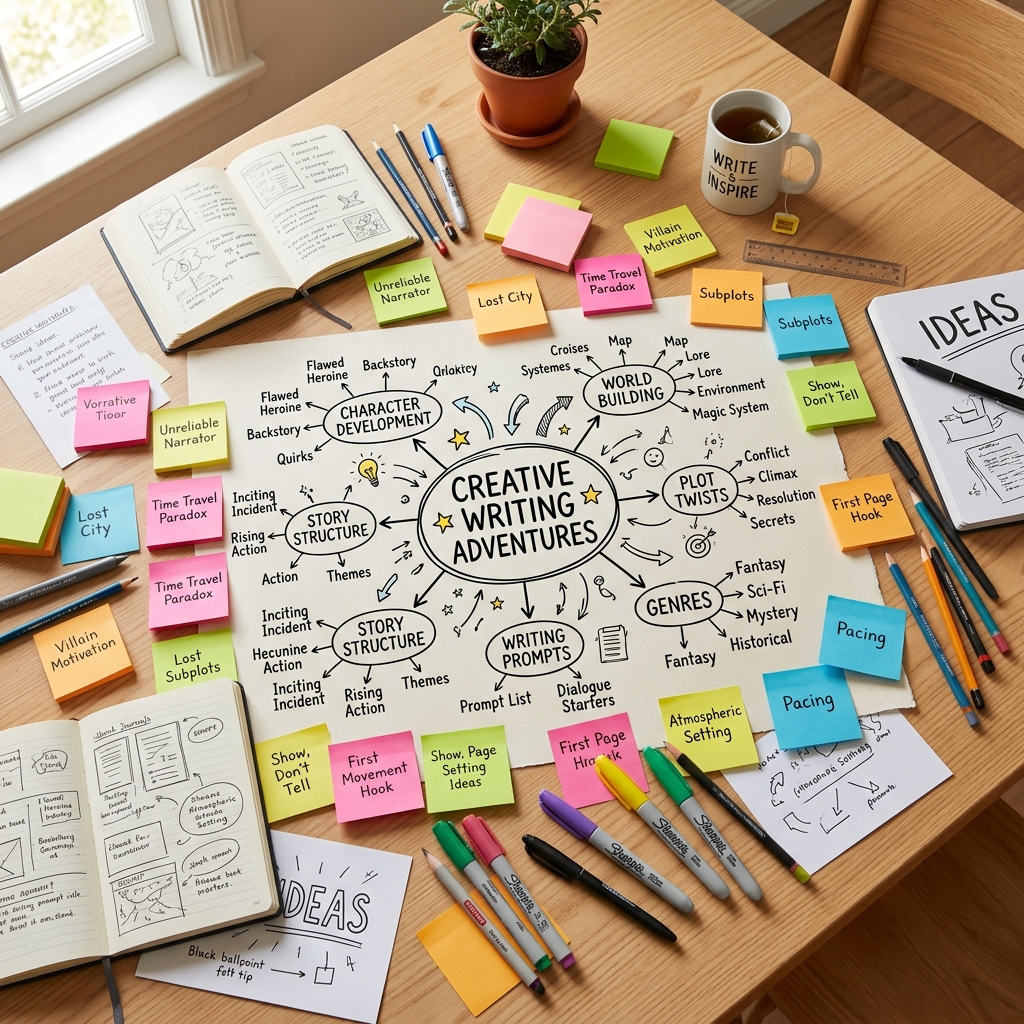
Here are a few story writing prompts to try:
- A character finds a library book that contains notes written by someone who knows their secret.
- Every year, a small town chooses one person to hear the truth about its past.
- Your main character wakes up with a message written on their hand: Do not trust the person in the red coat.
- A child's imaginary friend appears at the family dinner table after ten years.
- A storm knocks out power across the city, but one house still has all its lights on.
- Two strangers discover they have been receiving the same dream for a month.
- A young musician hears a melody coming from an abandoned house.
Do not worry about making the first version brilliant. Start with the moment that feels most exciting. Who is there? What do they want? What makes the situation difficult? Those three questions can lead you into almost any story.
For example, take the library-book prompt. A simple version might begin with a student finding a note. A stronger version starts when the note mentions something no stranger should know. Now the student has a reason to keep reading. There is a mystery, a risk, and a question the reader wants answered.
If you need creative writing ideas, look around you. A lost glove on a bench, a closed shop with a broken sign, a person laughing alone on a bus, or a photo in an old drawer can all become the beginning of a story. Writers are not people who have more interesting lives than everyone else. They are people who notice ordinary things and ask, "What could this mean?"
Writing prompts for students
Writing prompts for students should feel open, clear, and fun. A prompt should invite a response, not make students feel as though they must guess the teacher's answer.
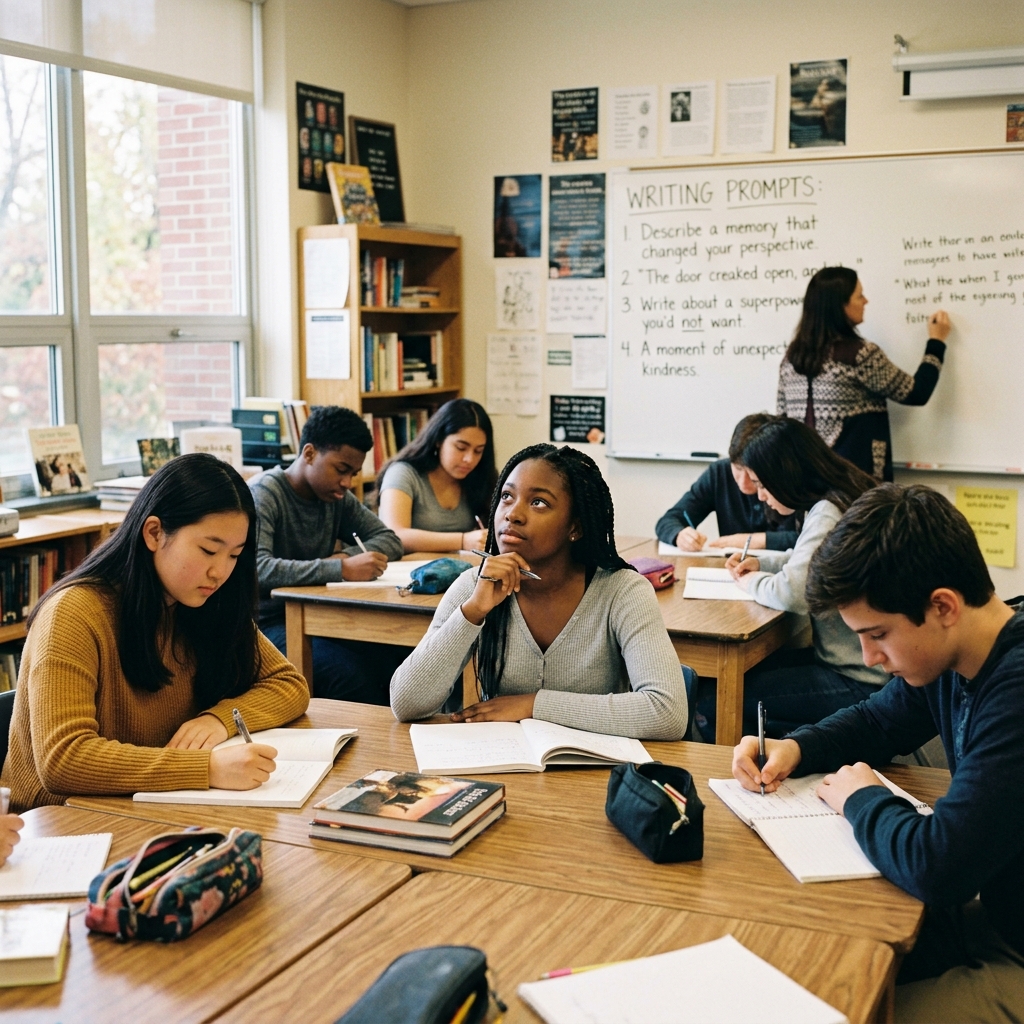
For younger students, concrete prompts work well. They can use objects, animals, places, and funny situations. Try these:
- Your backpack starts talking on the way to school. What does it say?
- You discover a tiny door behind your bedroom wall.
- Write about the best sandwich in the world and the strange shop that sells it.
- A friendly dragon joins your class for one day.
- If you could make one new school rule, what would it be?
Older students often enjoy prompts that include choices, friendship, identity, and change. These are useful creative writing prompts for students:
- A student must choose between protecting a friend and telling the truth.
- Your character receives an email meant for somebody else.
- On the final day of school, someone leaves a box under a desk with one instruction: Give this to the person who needs it most.
- A teenager returns to their childhood home and finds a room that was never there before.
- Write a story about a small mistake that becomes a much bigger problem.
Students can also write from real experience. Personal writing does not need to share private details. A student might write about a time they felt proud, nervous, left out, surprised, or grateful. These moments teach writers how emotions work, which helps them create stronger fictional characters too.
A simple classroom practice is a ten-minute writing sprint. Give everyone a prompt, set a timer, and ask them to keep their pencil moving. Tell students that spelling and grammar can be fixed later. The first job is to get ideas on the page.
Writing prompts for teachers
Writing prompts for teachers can save planning time while making lessons more lively. A prompt can be used as a warm-up, a quiet activity after lunch, a discussion starter, a homework task, or a bridge into a larger unit.
Teachers can match prompts to a skill they want students to practice.
For character:
"Write about a person who is very good at hiding how they feel. What finally makes them speak honestly?"
For setting:
"Describe a familiar place during a power cut. What sounds become louder? What looks different?"
For dialogue:
"Two people want the same thing, but neither is willing to say it directly."
For point of view:
"Tell the same event first through the eyes of a student, then through the eyes of a school caretaker."
For reflection:
"Write about a challenge you handled better than you expected. What helped you?"
Good educational writing resources do not only give students topics. They help students learn how stories work. After a short writing activity, teachers can ask questions such as: What does the character want? Where did the story change? Which detail creates the mood? These questions teach craft without making writing feel like a test.
Teachers can also offer choices. One student may enjoy a mystery prompt, another may want a funny prompt, and another may prefer a journal entry. Choice gives students ownership, and ownership often leads to better writing.
Journal prompts for everyday thinking
Journal prompts are different from story prompts, though they can lead to stories later. A journal is a place to notice your thoughts, record moments, explore feelings, and make sense of your day. It does not have to be private diary writing. It can be lists, questions, memories, observations, or short paragraphs.

Try these simple journal prompts:
- What is one small thing that made today better?
- Describe a place where you feel calm.
- What is something you wish people understood about you?
- What would you tell your younger self?
- What are you looking forward to this week?
- Describe a conversation you keep thinking about.
- What did you learn today that surprised you?
Daily writing prompts can make journaling easier. You do not need to write for an hour. Five minutes each morning or evening is enough. The habit matters more than the length.
Journaling also gives you writing inspiration. A sentence you write about a rainy walk may later become the opening of a story. A memory about a family meal may become a character scene. A question you cannot answer may become the theme of a poem.
Free writing prompts and where to find them
You do not need to pay for ideas. There are many free writing prompts available in libraries, classroom resources, writing communities, and simple lists like this one. The best writing prompt website is not always the one with the most prompts. It is the one that makes you want to write.
When looking for prompt websites or educational writing resources, choose places that are clear, safe, and easy to use. A useful site may organise prompts by age, theme, genre, or skill. It may offer prompts for fiction, nonfiction, poetry, journaling, and classroom lessons.
But remember: you can create your own prompt bank. Keep a note on your phone or in a notebook called "Ideas." Add to it whenever you notice something interesting.
You might collect:
- Snippets of conversation
- Strange dreams
- Questions you cannot answer
- Interesting names
- Places you want to describe
- Objects with a story behind them
- News headlines that make you curious
- Memories that still have a strong feeling attached to them
Over time, this becomes your own best writing prompt website—one that knows exactly what interests you.
How to use a prompt without feeling trapped
Some writers avoid prompts because they think using one means the work will not be original. That is not true. A prompt is a seed, not a finished tree.
You can change anything. If a prompt says "Write about a haunted house," you might write about a house haunted by happy memories instead of ghosts. You might set it on a space station, tell it from the house's point of view, or turn it into a comedy.
Try this simple method:
- Read the prompt.
- Write the first idea that comes to mind.
- Change one important part.
- Ask what the character wants.
- Give them a problem.
- Write for ten minutes without stopping.
For example, the prompt "A door appears in a wall" could become a fantasy story. Change one part: the door only appears in a school hallway after someone tells a lie. Now you have a different idea. Who sees it? Why does it appear? What is behind it? Each question gives you another piece of the story.
Building a daily writing habit
The easiest way to improve is to write regularly. You do not need to wait until you feel inspired. In fact, writing often creates inspiration.
Choose a small goal. Write 100 words a day. Write for ten minutes. Respond to one prompt before bed. The goal should be small enough that you can keep it even on a busy day.

Here is a simple seven-day plan:
Day 1: Write about an object you have owned for a long time.
Day 2: Write a conversation between two people waiting for the same bus.
Day 3: Use a prompt and write a 300-word story.
Day 4: Describe a place using all five senses.
Day 5: Write a journal entry from the point of view of a fictional character.
Day 6: Revise something you wrote earlier in the week.
Day 7: Read your work and circle one sentence you genuinely like.
Do not skip the last step. Writers often focus only on what is weak. Learning to notice what works is just as important. A good sentence, a clear image, or a believable line of dialogue is evidence that you are improving.
A final reminder for every writer
Writing ideas are everywhere, but you have to give yourself time to catch them. Use a prompt when you feel stuck. Keep a journal when you have too many thoughts. Write a scene when you only have ten minutes. Try a funny idea when serious writing feels heavy.
The page does not need your best work today. It needs your honest attempt.
Start with one of these creative writing prompts. Write a messy paragraph. Give a character a problem. Describe one strange object. Ask one question that makes you curious.
Then keep going.
Every story begins with a small moment when someone decides to write the next line.
You May Also Like
Read more tips, guides, and creative writing strategies:
15 Storytelling Techniques for Beginners: A Practical Creative Writing Guide
2026-07-21 • 29 min read
200+ Writing Prompts for Students: Creative, Daily & Reflective Ideas
2026-07-16 • 19 min read
150+ Kindergarten Writing Prompts: Spark Early Literacy and Creative Joy (2026 Guide)
2026-07-14 • 43 min readRoll the Story Builder Dice!
Feeling stuck? Roll our interactive story dice to generate thousands of unique, creative writing prompts instantly and start writing.
Play Game 🎲