150+ Kindergarten Writing Prompts: Spark Early Literacy and Creative Joy (2026 Guide)
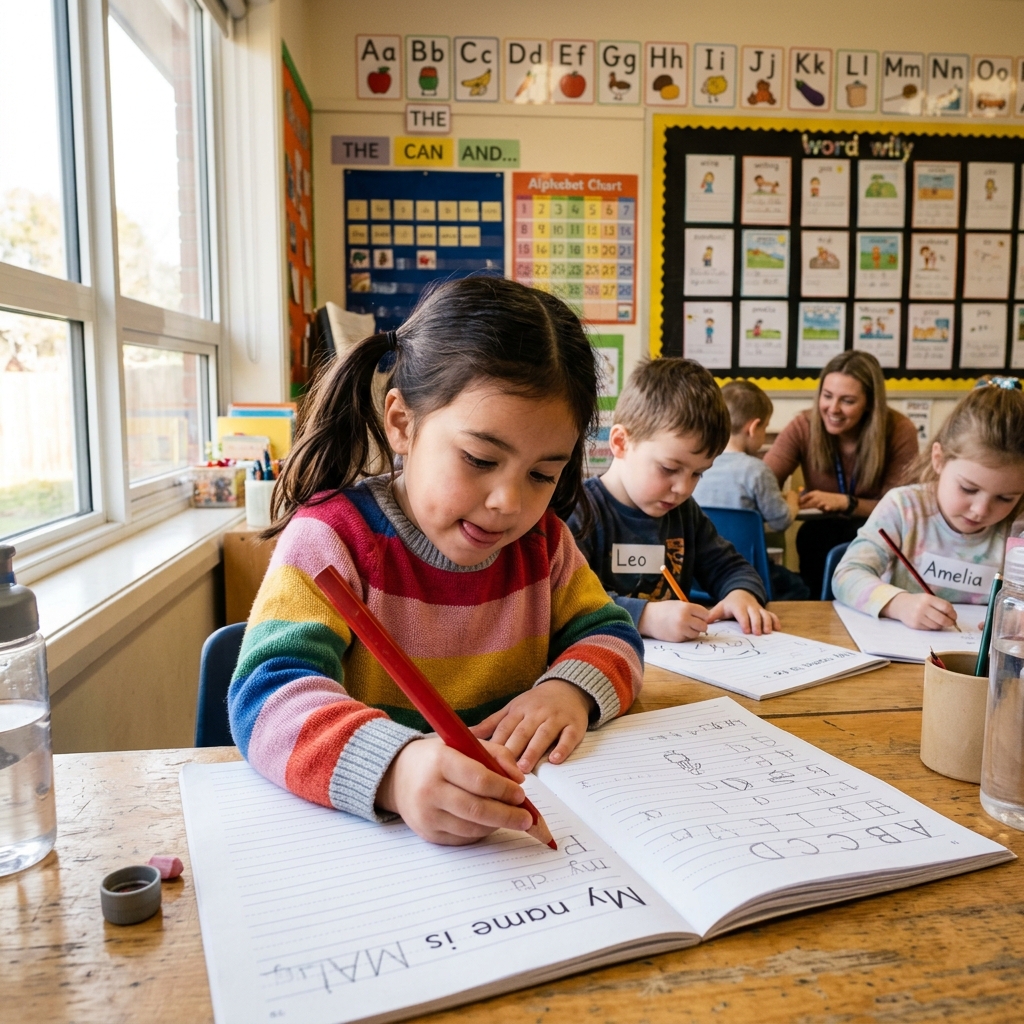
KINDERGARTEN WRITING PROMPTS: THE COMPLETE GUIDE TO RAISING CONFIDENT YOUNG WRITERS
Why That Blank Page Isn't Just a Blank Page: How Kindergarten Writing Prompts Transform Children's Developing Minds
There's a moment that happens in kindergarten classrooms everywhere, usually around late October or early November. A child who has been watching their teacher write words on the whiteboard for months suddenly picks up their own pencil, looks at that blank page, and makes their first real attempt at communicating through writing.
Their tongue might poke out in concentration. They might say each letter out loud as they form it. The pencil grip will be imperfect—wrapping around the pencil like they're holding a dinosaur bone, maybe—but they're writing. They're really writing.
And then, almost inevitably, they look up at you with huge eyes and say those seven words that can break a teacher or parent's heart: "How do you spell...?"
What happens next in that moment will shape how this child feels about writing for years to come.
If you say, "Sound it out," or "It's in the word wall, find it yourself," or (worst of all) "That's not a word, honey, draw a picture instead," you might be unintentionally sending the message that writing is something other people do—people who already know how to spell, people who make letters perfectly straight, people who don't need help.
But if you say, "You're writing! Let me hear your word. Let's figure out the first sound together," and then you write the conventional spelling next to their best attempt—preserving their courage while showing them the goal—you're doing something powerful. You're building what researchers call "self-efficacy for writing." And that belief—that they can write, that their thoughts matter enough to be written down—might be the most important thing they learn all year.
This is the power of kindergarten writing prompts done right.
Not as worksheets. Not as morning work that feels like a test. But as invitations to think, to imagine, to express, and to discover that they have something to say.
In this comprehensive guide, we're going to explore exactly how to use writing prompts with kindergarten-aged children (typically ages 5-6, though developmental readiness varies enormously). We'll dive into the psychological research about why early writing experiences matter so much. We'll look at how the brain develops writing skills. We'll explore 150+ specific prompts organized by type, season, and skill level. And we'll talk about the mistakes that can turn writing time into a daily battle—and how to avoid them.
Whether you're a kindergarten teacher with 25 wiggly students, a parent homeschooling your kindergartner, a special education teacher adapting materials, or anyone who cares about early literacy, this guide is for you.
Because here's the thing that the research makes crystal clear: kindergarten isn't too early to start writing. In fact, it might be the most important time to start. The foundations of writing identity are being poured right now, and once they set, they're remarkably hard to chisel away and redo.
So let's talk about how to make sure those foundations are strong, supportive, and—this part matters enormously—built on joy rather than anxiety.
The blank page isn't the enemy. It's an invitation. Let's teach our kindergarteners how to accept it.
================================================================================
TABLE OF CONTENTS
- The Psychology and Brain Science of Kindergarten Writing
- Why Writing Prompts Work for 5-6 Year Olds
- 150+ Kindergarten Writing Prompts by Category
- Picture Prompts (Visual Writing Starters)
- Sentence Starters and Stems
- Seasonal and Holiday Prompts
- Imaginative Prompts
- Everyday Life Prompts
- Feelings and Social Prompts
- Alphabet and Phonics-Based Prompts
- Collaborative and Interactive Prompts
- How to Introduce Writing Prompts in Kindergarten
- Supporting Different Learning Needs and Styles
- Common Mistakes and How to Avoid Them
- Building the Home-School Connection
- Assessing Progress Without Killing Joy
- Frequently Asked Questions
- Conclusion
================================================================================
Writing activates more areas of a child's developing brain than almost any other early childhood activity—which is why those early experiences matter so much.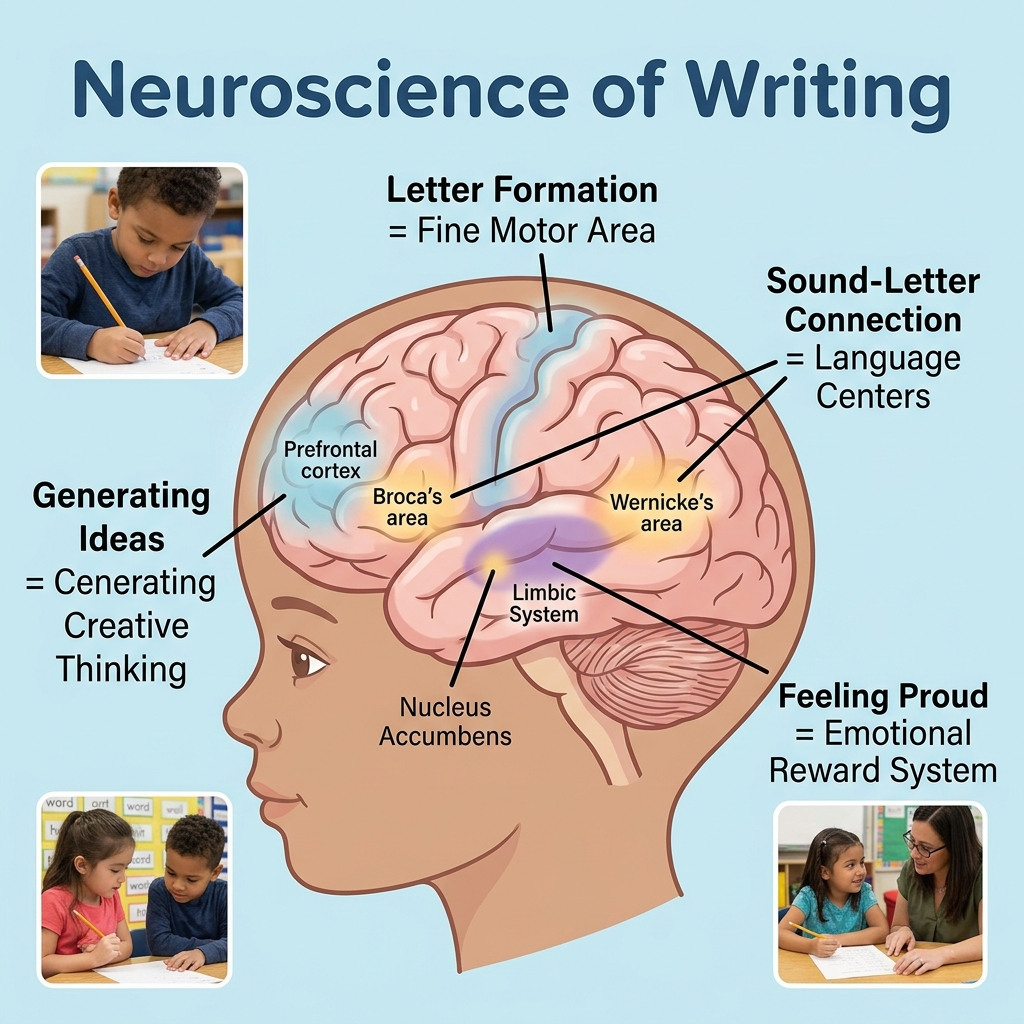
- The Psychology and Brain Science of Kindergarten Writing: What Every Parent and Teacher Should Know
The Window of Maximum Plasticity: Why Kindergarten Is a Pivotal Time
Here's a psychological fact that should make every early childhood educator lean in: the human brain reaches its peak plasticity—its ability to form new neural connections rapidly—between ages 3 and 7. After that window, learning doesn't stop (thank goodness), but it requires more effort and repetition.
Writing, it turns out, is one of the most complex tasks we ask young brains to perform. It's not just one skill—it's a symphony of skills happening simultaneously:
- Fine motor coordination: Holding the pencil, applying the right pressure, forming letters with controlled movements
- Visual processing: Seeing letters on the page (or in the mind's eye) and reproducing them
- Phonological awareness: Connecting sounds to letters, remembering letter shapes
- Working memory: Holding the idea they want to express while manipulating the pencil
- Executive function: Planning what to write, monitoring if it matches their intention, persisting through challenges
- Emotional regulation: Managing frustration when it's hard, feeling proud when it works
When a kindergartener engages with a well-designed writing prompt, all of these systems are firing. And here's the beautiful part: because their brain is so plastic, each time they write, they're quite literally building the neural pathways that will make writing easier next time.
But—and this is a critical "but"—those pathways can be built with either confidence or anxiety running alongside them.
Psychologist Albert Bandura coined the term "self-efficacy," which he defined as a person's belief in their ability to succeed in specific situations. Research consistently shows that children with high self-efficacy for writing write more, persist longer when writing is challenging, and produce higher-quality work. Children with low self-efficacy avoid writing, give up quickly, and produce less.
And self-efficacy for writing is largely set by the end of first grade.
Think about that. By age 7, most children have already decided whether they're "good at writing" or not. And those decisions are based not on their actual ability, but on their early experiences.
Did writing feel possible? Did adults respond to their early attempts with enthusiasm and support? Were they allowed to make mistakes and revise, or was every error immediately corrected?
This is why the prompts we use, the way we introduce them, and the responses we give to kindergarten writing matter more than almost any other instructional decision we make.
The Role of Schema Theory: Why "Relatable" Prompts Work Better
Cognitive psychologists use the term "schema" to describe the mental frameworks we build based on experience. A child who has been to a farm has a "farm schema"—they know there are animals, there's a barn, farmers wear overalls, etc. When they encounter new information about farms, they fit it into that existing schema.
Here's why this matters for writing prompts: kindergarten children write best about what they already have schemas for.
If you give a prompt about "a time you went to the doctor," every child who has been to a pediatrician's office has a rich schema to draw from. They can close their eyes and remember the waiting room, the scale, the tongue depressor, the lollipop at the end. They have details. They have feelings. They have a story.
But if you give a prompt about "a time you traveled by airplane," you've just excluded every child who hasn't been on a plane. Their schema is empty. They might be able to write "I went on a plane and it was fun," but they can't elaborate because they don't have the experiential detail to draw from.
This is why the best kindergarten writing prompts are rooted in universal childhood experiences: playing outside, eating favorite foods, celebrating birthdays, feeling scared or brave, losing a tooth, making a friend.
When we use prompts that connect to children's existing schemas, we're not just giving them something to write about. We're helping them discover that their lived experience is worth writing down. That's a profound shift.
- Why Writing Prompts Work for 5-6 Year Olds: The Research Behind the Practice
If you've ever watched a kindergarten child stare at a blank page for ten minutes, pencil hovering, you know that "free writing" isn't always the gift of creativity we intend it to be. For many children, the blank page isn't freeing—it's paralyzing.
Writing prompts work because they provide what psychologists call "scaffolding." Just as a scaffold supports construction workers as they build, writing prompts support young writers as they develop their skills.
Let's look at what the research says about why prompts are particularly effective for this age group.
Reducing Cognitive Load So Creativity Can Emerge
Cognitive Load Theory, developed by educational psychologist John Sweller, suggests that our working memory has limited capacity. When we're asking young children to write, we're asking them to manage an enormous cognitive load:
- What do I want to say?
- How do I spell that word (or my best guess at it)?
- How do I form this letter?
- Where am I on the page?
- What comes next?
When a child has to generate both the idea AND the words AND the mechanics simultaneously, something gives. Usually, it's the idea. They default to "I like dogs" because generating a more complex thought while managing mechanics is simply too much.
A writing prompt removes the "what do I write about?" burden. That cognitive load is reduced. Now the child can focus their limited working memory on expressing the idea, approximating spelling, forming letters.
And here's the key insight: as children become more fluent with mechanics (as letter formation becomes automatic, as they build a repertoire of known sight words), they can handle more complex prompts. The scaffold can be gradually removed.
This is why prompt complexity should increase across the kindergarten year. In September, prompts might be pure drawing with one labeled word. By May, some children will be attempting three-sentence responses. The prompt scaffold allowed them to build up to that.
Building the "Can Do" Attitude: Success Spirals in Early Writing
Remember that self-efficacy we talked about? Writing prompts, when well-designed, create what researchers call "success spirals."
Here's how it works: A child encounters a prompt that's appropriately challenging—not so hard that they can't do it, not so easy that it's boring. They write. The teacher or parent responds with genuine enthusiasm ("You wrote 'I like to play.' Look at that 'I' you made! And I can read your whole sentence!"). The child feels successful.
Because they feel successful, they're willing to try again tomorrow. Each day's small success builds on the previous day's. By the end of the year, they've internalized the message: "I am a writer. Writers write. I can do this."
Contrast this with what happens when we don't provide appropriate scaffolds. A child sits at the blank page. They don't know what to write. They look at their neighbor's page, which is filled with writing. They feel like a failure. Tomorrow, they'll be even more reluctant to try.
The prompt is the difference between those two trajectories.
================================================================================
The right prompt at the right moment doesn't just give a child something to write about—it gives them the belief that they can do it.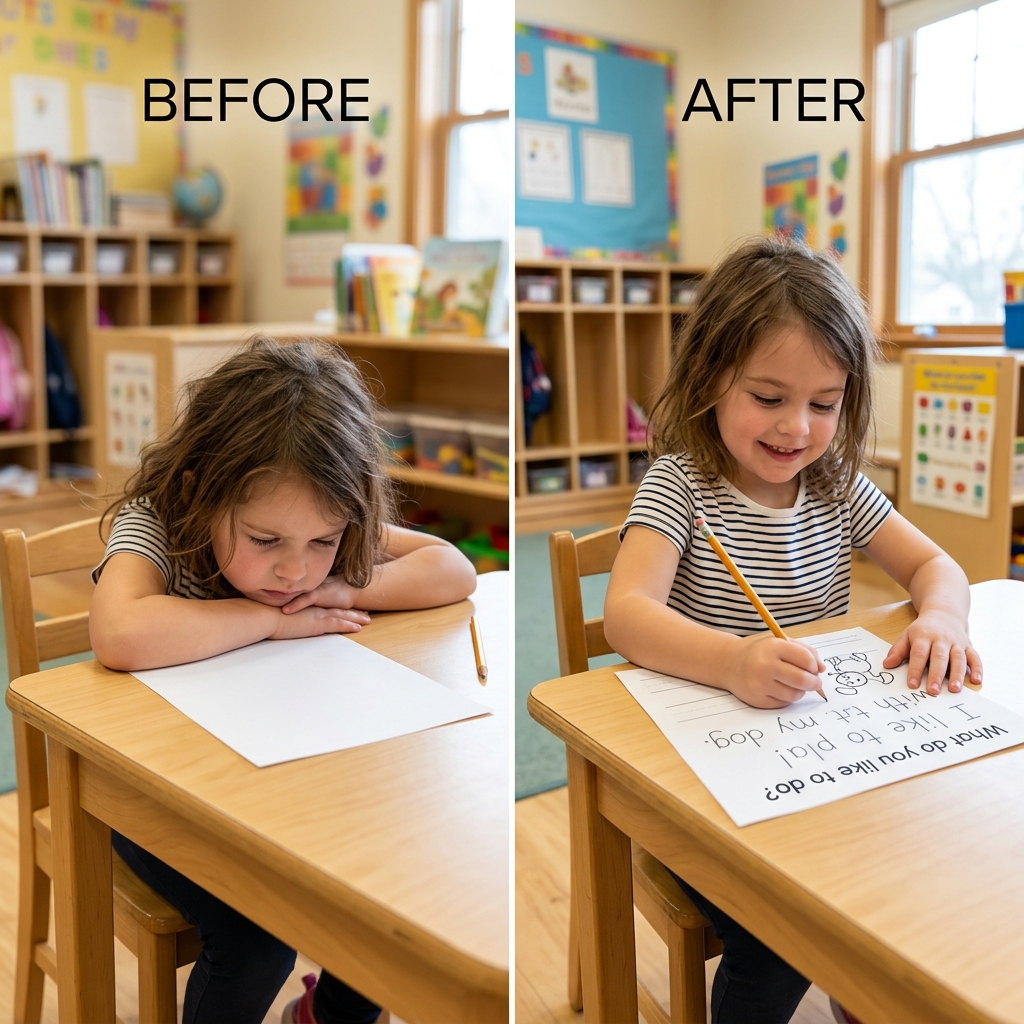
- 150+ Kindergarten Writing Prompts by Category: Everything You Need for the Whole Year
Now for the heart of this guide: the prompts themselves. I've organized these into categories so you can easily find prompts that match your teaching goals, the season, your students' interests, and their developmental levels.
A few important notes before we dive in:
These prompts are starting points, not scripts. If a child takes a prompt in a completely different direction, that's not "not following directions"—that's creativity. Encourage it.
Differentiate by response mode. Some of your kindergarteners will be writing sentences in October. Others will still be drawing with invented spelling labels. Both are appropriate responses to the same prompt. Meet each child where they are.
The best prompt delivery is oral. Don't just hand out a worksheet with a prompt. Gather children together, read or tell the prompt, have a two-minute conversation about it, then send them off to write. That oral processing time is gold.
Let's get to the prompts.
Category 1: Picture Writing Prompts (Visual Spark Starters)
These are prompts where you show a photograph or illustration and ask children to write about what they see, imagine, or wonder.
Why pictures work: Kindergarten children are visual learners. A compelling image gives them details to observe and describe. It also levels the playing field—children with less language experience can still succeed with visual prompts.
Show a photograph of a playground. Prompt: "Write about a time you played on a playground. What was your favorite thing to play on? How did you feel?"
Show a picture of a rainy day with puddles. Prompt: "Have you ever jumped in a puddle? Write about it. What did the water feel like? Did you get wet?"
Show an image of a child's bedroom (different from theirs). Prompt: "Look at this bedroom. If this was your bedroom, what would you add? What would you change? Write about your dream bedroom."
Show a photograph of a dog playing fetch. Prompt: "If you could play fetch with any animal (not just dogs), what animal would you choose? Write about playing with them."
Show a picture of a birthday cake with candles. Prompt: "Write about your last birthday. How old did you turn? What was your favorite part of the day?"
Show an image of autumn leaves. Prompt: "In the fall, leaves change colors. What's your favorite color leaf? Write about jumping in a pile of those leaves."
Show a photograph of a snowperson. Prompt: "Have you ever built a snowperson? Write about building one. What did you use for the eyes and nose?"
Show a picture of a garden with vegetables growing. Prompt: "If you could grow any food in a garden, what would you grow? Write about your garden."
Show an image of children on a school bus. Prompt: "Write about your ride to school. Who do you sit with? What do you talk about? What do you see out the window?"
Show a photograph of the night sky with stars. Prompt: "If you could wish on a star, what would you wish for? Write about your wish."
Category 2: Sentence Starters and Writing Stems (Building Fluency)
These prompts provide the beginning of a sentence and ask children to complete it. They're especially good for children who are ready to write sentences but need support with generating ideas.
Why stems work: They reduce the cognitive load of starting from scratch, but still require the child to generate content. They also provide implicit models of sentence structure.
"I like to..." (Children complete with an activity they enjoy)
"My favorite food is... because..." (Introduces "because" for adding reasons)
"I feel happy when..." (Connects writing to social-emotional learning)
"If I had a superpower, it would be..." (Imaginary prompts build engagement)
"My best friend is..." (Encourages descriptive writing)
"I want to learn how to..." (Forward-looking, growth mindset)
"At school, I like to..." (Connects writing to their daily experience)
"My favorite animal is... because..." (Another "because" prompt for building complex sentences)
"When I grow up, I want to be..." (Aspirational writing)
"I can help at home by..." (Connects to family and responsibility)
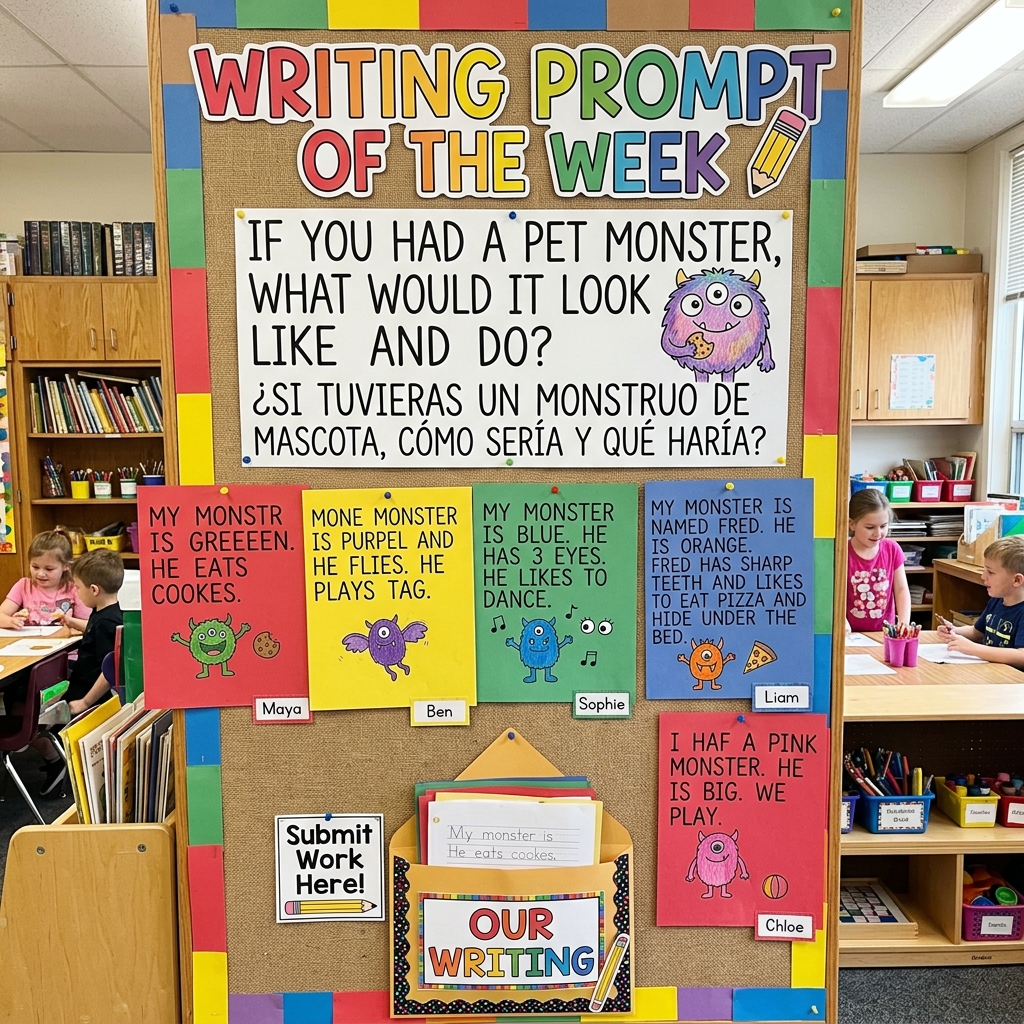
Pro Tip: Write these stems on sentence strips or display them on a writing prompt board. Children can point to the stem they want to use, reducing even further the barrier to starting.
When writing prompts are visible, celebrated, and returned to throughout the week, they become anchors of classroom community—not just assignments to complete.
Category 3: Seasonal and Holiday Prompts (Connecting to Children's Lives)
Kindergarten children experience the year through landmarks: the first day of school, Halloween, winter break, spring thaw. Using seasonal prompts helps writing feel relevant to what they're experiencing right now.
Fall/Autumn Prompts:
"Write about a leaf. What color is it? What does it sound like when you step on it? Where did it come from?"
"If you were a scarecrow, what would you wear? What would you see all day long? Write about your day as a scarecrow."
"Write about going apple picking. How do you get the apples off the tree? What do they taste like?"
"In the fall, the weather gets cooler. Write about your favorite coat or sweater. Why do you like it?"
"Halloween is coming. If you could choose any costume, what would you be? Write about wearing that costume."
Winter Prompts:
"Write about building a snowman. What do you need? What do you do if it gets too cold?"
"If snow was a color besides white, what color would you want it to be? Write about a world with that color snow."
"Write about a winter holiday your family celebrates. What do you eat? What do you do? Who comes to visit?"
"When it's cold outside, what's your favorite thing to do inside? Write about staying cozy."
"If you could give a gift to everyone in the world, what would it be? Write about your gift."
Spring Prompts:
"Write about a flower growing. What does it need to grow? How long do you think it takes?"
"In the spring, baby animals are born. If you could pick any baby animal to visit your classroom, what would you pick? Write about taking care of it."
"Write about flying a kite. What does the wind feel like? How do you run to make the kite go up?"
"When it rains, the world smells different. Write about the smell of rain and what you like to do on rainy days."
"Spring means the days are getting longer. Write about playing outside in the evening when it's still light out."
Summer (End of Year) Prompts:
"Write about your favorite thing to do in the summer. Is it swimming? Riding your bike? Eating ice cream?"
"If you could go anywhere on vacation, where would you go? Write about what you would do there."
"Write about going to the beach. What does the sand feel like? What does the ocean sound like?"
"Summer means no school (or a different school). Write about what you're excited to do this summer."
"If you could plant a garden that grew any food you wanted, what would you plant? Write about your magical garden."
Category 4: Imaginative and "What If" Prompts (Where Creativity Takes Off)
Kindergarten children haven't yet fully separated fantasy from reality, and that's a gift for writing. These prompts invite them into worlds where anything is possible.
"What if dogs could talk? What do you think your dog (or a dog you know) would say? Write a conversation with a talking dog."
"What if you woke up one morning and you were as tiny as an ant? Write about your day. What's hard about being small? What's fun?"
"What if you found a magic crayon that could draw things that came to life? What would you draw first? Write about your magic picture."
"What if you could fly? Where would you fly to? What would you see from up high? Write about your flying adventure."
"What if animals had their own school? What subjects would they learn? Who would be the teacher? Write about animal school."
"What if you switched places with your teacher for one day? What would you teach? What rules would you make? Write about being the teacher."
"What if trees could walk? Where would they walk to? Why would they move? Write a story about a walking tree."
"What if you found a door that was exactly your size, but it led to a different world? Where does it go? Write about opening that door."
"What if you could breathe underwater? What would you discover in the ocean? Write about being a merman or mermaid."
"What if clouds were made of cotton candy? What would the world taste like? Write about a cotton candy rain day."
Psychological Note: Imaginative prompts aren't just fun—they build "divergent thinking," which psychologists define as the ability to generate creative ideas by exploring many possible solutions. In one famous study, researchers found that children's divergent thinking scores decline significantly after they enter formal schooling. Writing prompts that encourage imagination might help preserve that creative capacity.
Category 5: Everyday Life Prompts (Building Observation Skills)
These prompts help children notice and write about the small details of their daily lives. They build the habit of paying attention—a foundational skill for all writing.
"Write about your morning routine. What's the first thing you do when you wake up? What do you eat for breakfast?"
"Write about your walk or ride to school. What do you see? Do you hear anything interesting?"
"Write about your favorite lunch. What's in your lunchbox? Do you trade food with friends?"
"Write about recess. What games do you play? Who do you play with? What's your favorite thing to do?"
"Write about going to the grocery store. What do you help pick out? What's your favorite aisle?"
"Write about bath time or shower time. What toys do you bring? How do you get clean?"
"Write about bedtime. What's your bedtime routine? Do you read books? Do you have a nightlight?"
"Write about a meal your family eats together. What do you talk about? What's your favorite food that your family makes?"
"Write about a chore you help with at home. Why is it important? How do you feel when you help?"
"Write about your favorite place in your whole house. Why do you like it? What do you do there?"
When families celebrate writing at home—not by correcting every error, but by asking "Tell me about your writing"—children develop the confidence to keep trying.
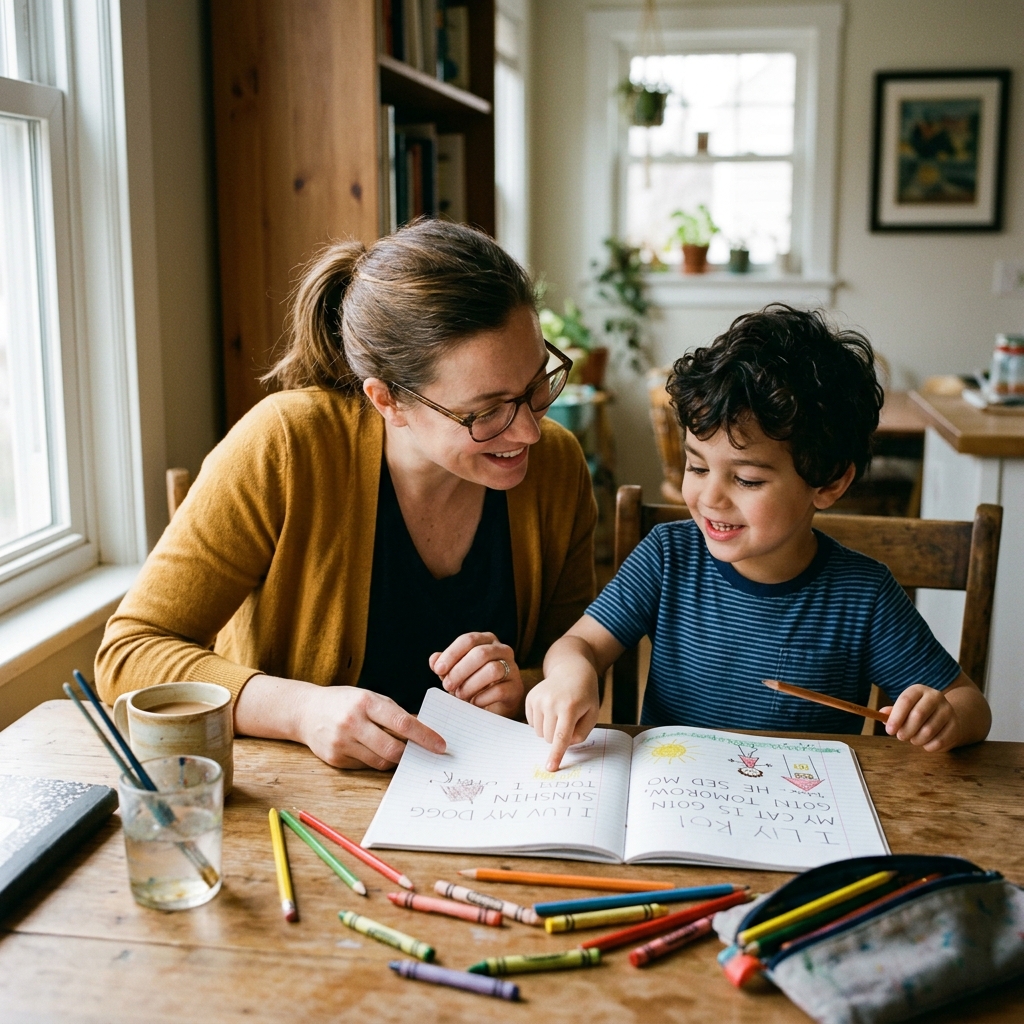
Category 6: Feelings and Social-Emotional Prompts (Writing as a Tool for Emotional Literacy)
Kindergarten is when children are first learning to identify, express, and regulate emotions in a school setting. Writing prompts that invite emotional reflection serve double duty: they build writing skills AND emotional intelligence.
"Write about a time you felt brave. What were you afraid of? How did you be brave anyway?"
"Write about a time you felt angry. What happened? What helped you feel better?"
"Write about a time you felt proud. What did you do? Who noticed?"
"Write about being a good friend. What do good friends do? How do they make each other feel?"
"Write about a mistake you made. What was it? How did you fix it? How did you feel after?"
"Write about feeling nervous. What makes you nervous? What helps you feel brave?"
"Write about being left out. Have you ever felt like you weren't included? How did it feel? What would you want someone to do?"
"Write about a time someone was kind to you. What did they do? How did it make you feel? How could you do that for someone else?"
"Write about feeling frustrated. What makes you frustrated when you're learning something new? What helps you keep trying?"
"Write about being thankful. What are three things you're thankful for? Why are they important to you?"
Research Note: A landmark study by educational researcher Angela Duckworth found that "grit"—passion and perseverance for long-term goals—predicts success more reliably than IQ or talent. Writing prompts that invite children to reflect on persistence, mistake-making, and emotional regulation are quietly building grit. They're also creating a record of their developing emotional intelligence that you can look back on with amazement.
Category 7: Alphabet and Phonics-Based Prompts (Building Skills Through Writing)
These prompts integrate writing with the phonics and alphabet work that's central to kindergarten. They help children see that writing isn't separate from "reading time"—it's a way to use what they're learning about letters and sounds.
"The letter A says /a/. Draw and write about something that starts with A." (Repeat for each letter, or do as a weekly alphabet book project.)
"Write all the words you can think of that rhyme with 'cat.' How many did you get?"
"Pick your favorite letter. Write three words that start with that letter. Draw pictures of them too."
"The sight word this week is 'the.' Write a sentence using the word 'the.' underline it when you find it in your sentence!"
"If you could eat a food for every letter of the alphabet, what would you eat? A is for apple. B is for... (continue through as many as you can)."
"Write about something that is RED. R says /r/. Red starts with R. Can you think of other R words?"
"We're learning about digraphs (two letters that make one sound). Write about a TH-ing (thumb, think, throw)."
"Write your name. Now write the names of three friends. What letters are in lots of names?"
"If you could be any letter of the alphabet, which would you be? Write about why. (I would be the letter B because I like bears and bananas!)"
"Write about the longest word you know. How many letters are in it? Can you draw a picture of what it means?"
Category 8: Collaborative and Interactive Prompts (Building Writing Community)
Writing doesn't have to be solitary. These prompts invite children to write as part of a community, which builds engagement and shows them that writing is a way to connect with others.
"Class Book: If I Were the Teacher..." Every child writes and illustrates one page. Bind them into a class book that lives in the reading corner.
"Question of the Day: What's your favorite [food/animal/color/book]? Write your answer and then we'll make a graph of our answers."
"Write a note to a friend. Tell them something you like about them. We'll deliver the notes at the end of the day."
"Class Mural: Write about your dream playground. Then we'll combine all our ideas to design a dream playground together."
"Pen Pal Project: Write to another kindergarten class in a different school. Tell them about your favorite thing to do at recess."
"Recipe Book: Write about your favorite food that your family makes. What's the recipe? We'll make a class recipe book to take home."
"If I Were in Charge of Recess..." Write a rule you would make if you were in charge of recess. Then vote on the best ideas as a class.
"Write a Thank You Note to..." (the custodian, the librarian, the principal, a parent volunteer). Learning that writing has real-world purposes.
"Prediction Journal: Our class is reading [book title]. Write what you think will happen next. Then we'll check if we were right!"
"Class Newspaper: Each child writes one 'news' item (something that happened to them, something they learned, something they're excited about). Compile into a weekly class newspaper."
Community Building Note: When children see their writing bound into books, posted on bulletin boards, or read aloud to the class, they receive a powerful message: "My writing matters to other people." This is the foundation of authentic writing purpose—not writing for a grade, but writing to communicate.
================================================================================
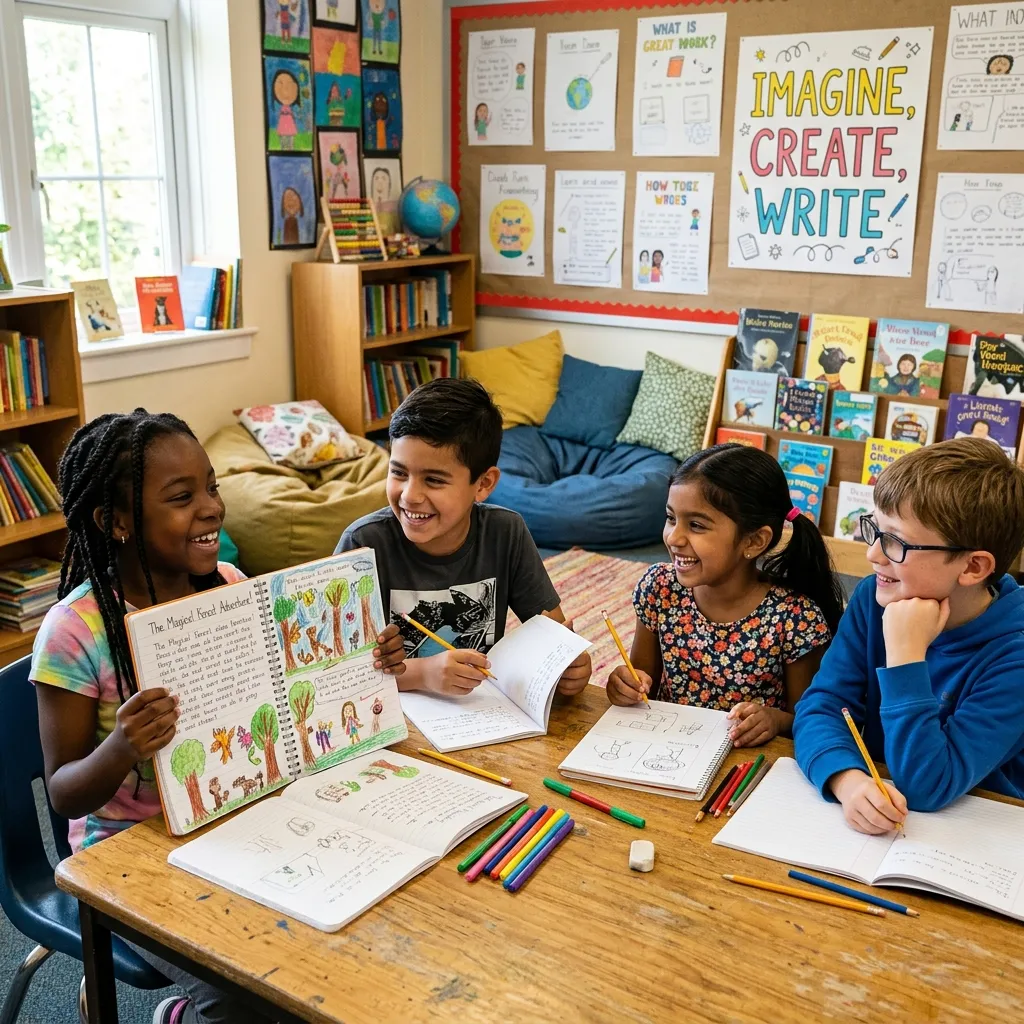
Writing time in kindergarten should be dynamic—some children writing independently, some consulting resources, some sharing with peers or teachers. One prompt, many pathways.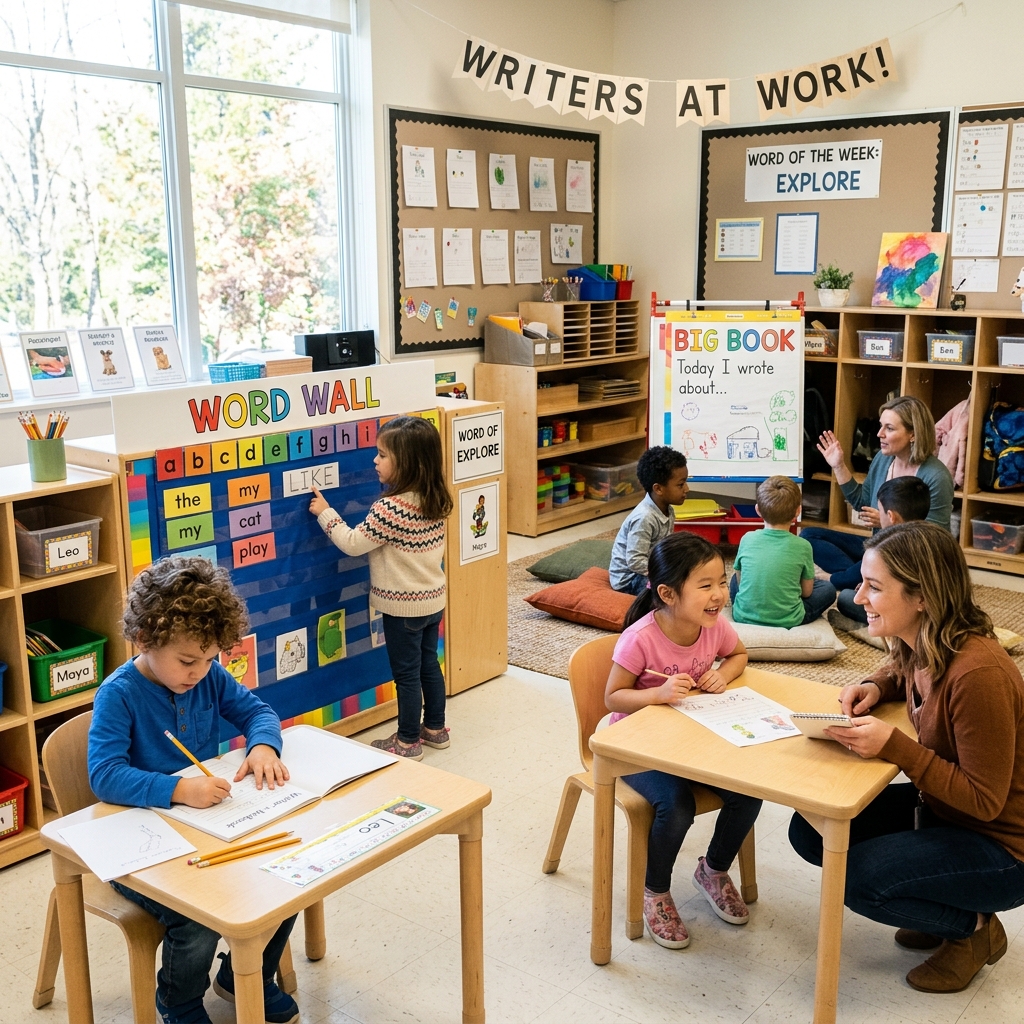
- How to Introduce Writing Prompts in Kindergarten: A Step-by-Step Guide
Knowing which prompts to use is only half the battle. How you introduce them—the rituals, the language, the physical setup—determines whether writing time becomes the best part of the day or a daily struggle.
Here's a research-informed approach to launching writing prompts in your kindergarten classroom (or home).
Week 1: Building the Writing Identity
Before you even give the first prompt, spend a week building what I call "writing identity." You want children to see themselves as writers before they ever put pencil to paper.
Day 1: "Writers Write About Their Lives" Read a picture book about writing (like "Ralph Tells a Story" by Abby Hanlon or "The Best Story" by Eileen Spinelli). After reading, gather children and say: "Did you know that you are all writers? Writers write about things that happen to them, things they imagine, things they care about. Today, I want you to just draw me a picture of something that happened to you. Tomorrow, we'll start adding words."
Notice: no prompt yet. Just building the identity. Let them succeed at the drawing (which all children can do) so they associate "writer's workshop" with "I can do this."
Day 2: "Writers Use Words" Today, after reading another writing-themed book, introduce the idea that writers add words to their pictures. Show them how you (the teacher) write a simple sentence about a picture you drew. Think aloud: "Hmm, I drew myself playing with my dog. I want to write 'I like my dog.' Let's sound out 'like'... /l/ /ī/ /k/... I hear L-I-K-E!"
Then have them try. No prompt yet—just "write about your picture." This builds the routine and the expectation.
Day 3: Introducing the First Prompt Now you're ready. Gather children and say: "Writers often get ideas by hearing a question or a starter. Today, I'm going to ask you a question, and I want you to write about your answer. Here's the question: 'What do you like to play?'"
Write the prompt where all can see. Read it aloud. Then ask: "Turn to your partner and tell them what you might write. What do you like to play?"
Give 60 seconds for partner talk. This oral rehearsal is crucial—it lets children practice their idea before the demanding task of writing it down.
Then send them off: "Now go write! Remember, writers do their best work when it's quiet enough to think. I'll be walking around to see all your amazing writing."
The Daily Writing Workshop Structure That Works
Once you've introduced prompts, here's a structure that works for most kindergarten classrooms:
1. Mini-Lesson (5-7 minutes) Gather children. Teach or review one small thing. Examples:
- "Today, writers, I want to show you how I stretch out a word and write the sounds I hear."
- "Writers, today let's remember to put spaces between our words. Watch how I do it..."
- "Today I'm going to teach you a new word to use in your writing. It's the word 'because.' Watch how I use it..."
2. Prompt Introduction (3-5 minutes) Introduce today's prompt. Write it large. Read it aloud. Have children turn and talk about what they might write.
3. Active Writing Time (10-20 minutes, gradually increasing) Children write independently. You confer with individuals or small groups. This is where the real teaching happens—not in the mini-lesson, but in the one-on-one "I notice... I wonder... Let me teach you..." moments.
4. Share Time (5 minutes) Gather back together. Have 2-3 children share what they wrote. Ask the group: "What did you notice about [child]'s writing? What did they do that writers do?" This builds community and lets children learn from each other.
Key Principle: Keep the instructional pieces short. Kindergarten attention spans are brief. Get them to the actual writing as fast as possible.
================================================================================
A predictable structure—mini-lesson, prompt introduction, writing time, sharing—helps kindergarteners know what to expect and builds writing stamina over the year.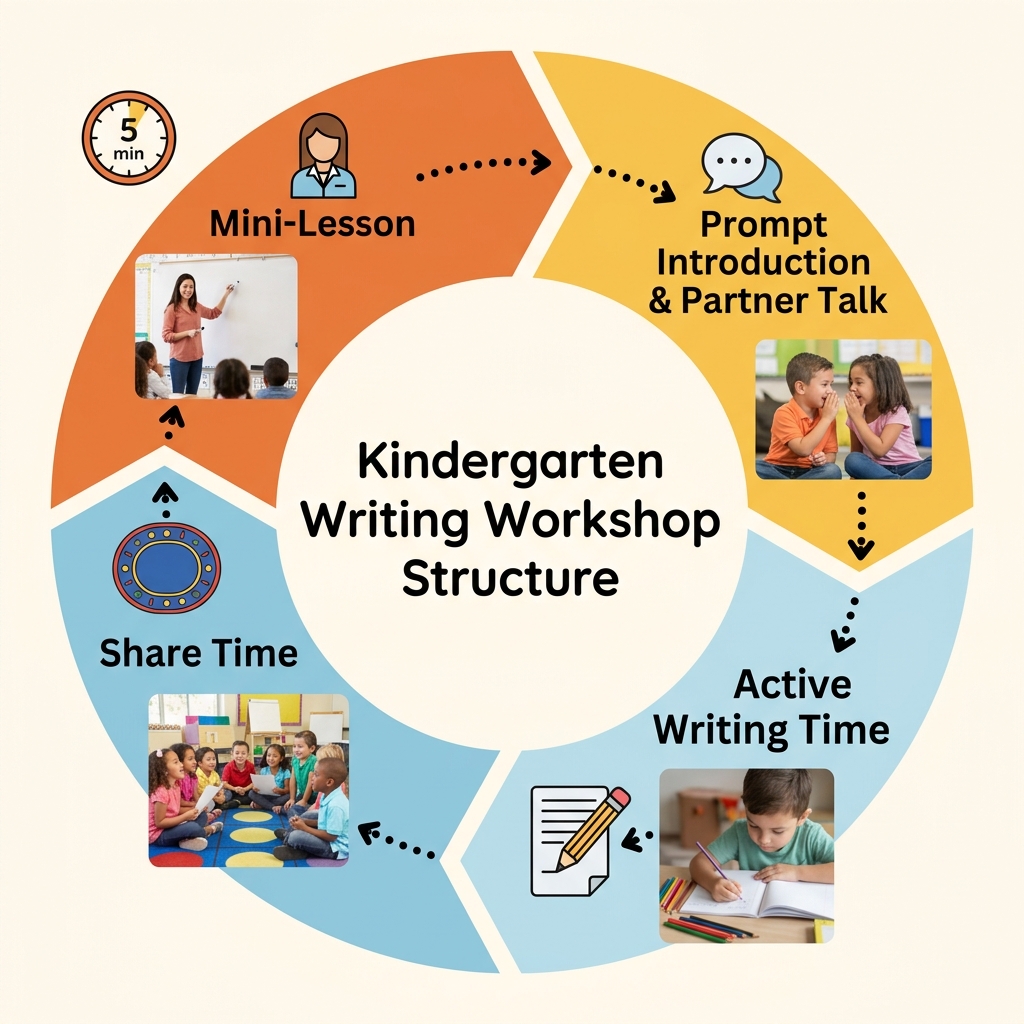
- Supporting Different Learning Needs and Styles in Kindergarten Writing
Not every child will respond to writing prompts in the same way. Here's how to adapt for diverse learners.
For the Reluctant Writer: Reducing the Affective Filter
In second language acquisition theory, there's a concept called the "affective filter"—the emotional barriers (anxiety, self-doubt, fear of embarrassment) that prevent learning. Reluctant writers have high affective filters around writing.
To lower it:
Make it social. Some children who freeze up when asked to write independently will flourish when allowed to "write" with a partner—one dictating while the other transcribes, then switching.
Allow alternative entry points. A child who "hates writing" might love creating a comic strip with speech bubbles. The words are still there—they're just supporting the pictures.
Celebrate approximation. When a child writes "I lk to pl" for "I like to play," that's not "wrong writing." That's brave writing. That's a child using what they know about sounds to communicate. Celebrate it fiercely.
Use their interests. If a child loves dinosaurs, every prompt can become a dinosaur prompt. "Write about a time you played" becomes "Write about a time you and your dinosaur friend played." Meet them where they care.
For the Advanced Writer: Providing Appropriate Challenge
Some of your kindergarteners will come in already writing sentences. They need different prompts—ones that stretch them.
Offer choice within the prompt. "Today's prompt is 'Write about something kind you did.' You can write one sentence, two sentences, or even three! You decide."
Introduce revision. "Wow, you wrote 'I helped my mom.' That's clear! What if you added HOW you helped? 'I helped my mom by...'"
Model elaboration. During share time, when a child shares a simple sentence, model: "Oh, I'm wondering... where were you when this happened? What did it look like? Could you add that to your writing?"
Connect to reading. "You know how in [favorite read-aloud], the author used exclamation marks when characters were excited? I noticed you're excited in your writing. Want to try adding an exclamation mark?"
For English Language Learners: Scaffolding Language Through Writing
Writing prompts are actually a powerful tool for language development—they give ELL students low-stakes opportunities to practice language.
Provide visual supports. If the prompt is "Write about what you eat for breakfast," have pictures of breakfast foods on the word wall. Point to them as you introduce the prompt.
Allow native language use. If a child wants to write (or label their drawing) in their home language, that's not "not following the prompt"—that's building literacy foundations. Celebrate it.
Partner with peers. Pair ELL students with bilingual peers or with children who are strong oral language models. The oral rehearsal before writing is even more important for these children.
Focus on communication over correction. If an ELL child writes "I eat cereal and milk," that's communicating! Don't immediately correct to "I eat cereal with milk." First, celebrate that they communicated a complete thought.
================================================================================
When we adapt our prompts and our support, every kindergartener can discover that they have something to say—and that their words matter.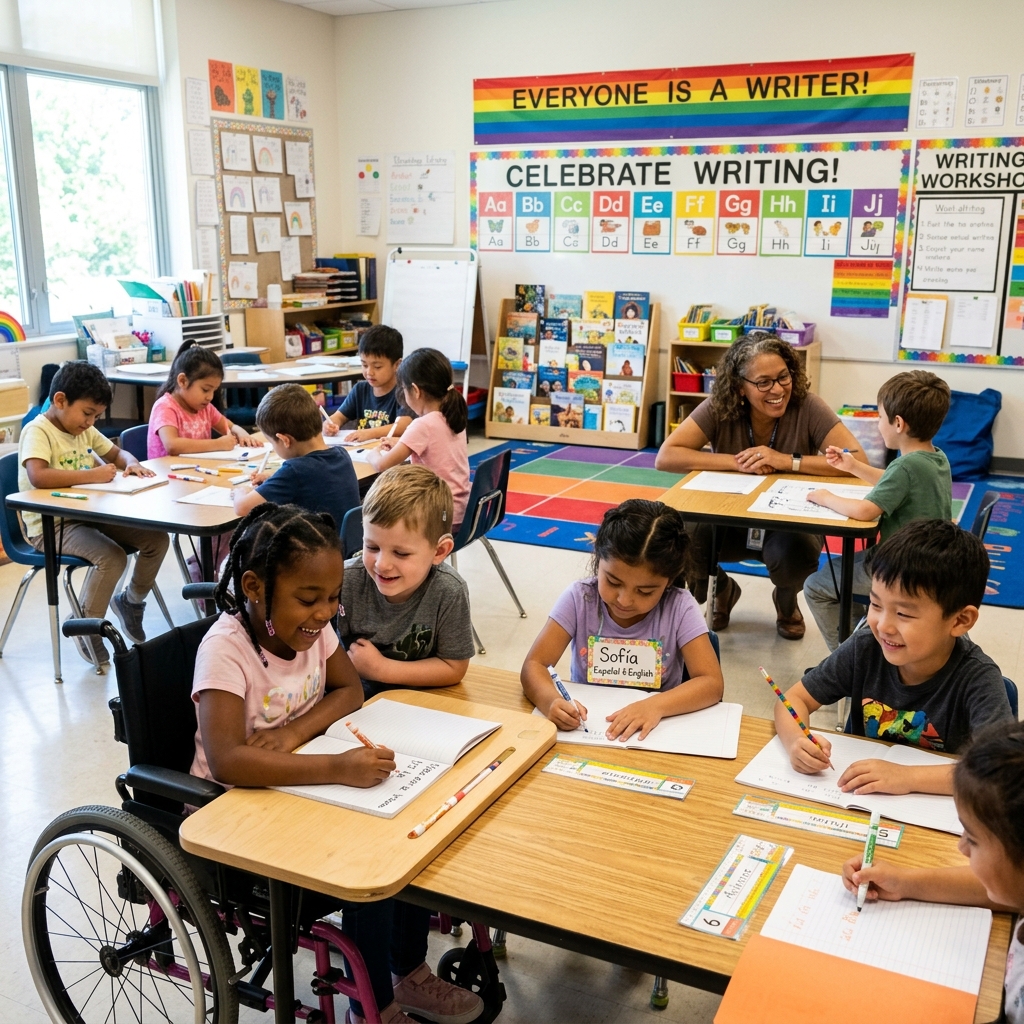
- Common Mistakes and How to Avoid Them: What the Research Warns Us Not to Do
Even with the best intentions, it's easy to accidentally make writing prompts stressful rather than joyful. Here are the most common mistakes—and how to course-correct.
Mistake #1: Correcting Every Error in Children's Writing
You're excited! A child wrote a sentence! And you can see exactly how to make it perfect! You grab a red pen...
Stop.
Research by educational psychologist Carol Dweck on growth mindset shows that when we focus children exclusively on "fixing" their work, they learn that writing is about not making mistakes, rather than about communicating ideas.
Better approach: Use a "sandwich" response. First, genuine specific praise ("I love how you sounded out 'because'! I can see b-e-c-a-u-s-e—you're really listening to sounds!"). Then, ONE gentle teaching point ("I noticed you're using periods. Let's find where this sentence ends and put a period there. Can you find it?"). Then close with celebration ("You're really becoming a writer. I can't wait to read what you write tomorrow!").
Also: not every piece of writing needs response. Sometimes, the child's own sense of accomplishment ("I wrote it!") is enough.
Mistake #2: Using Writing as Punishment
This can't be said strongly enough: never, ever use writing as a consequence.
"you talked during the lesson, so now you have to write three sentences about why that was wrong."
Do you see what you've just taught? You've taught that writing is something that happens to you when you're in trouble. That association can last for years.
If a child needs a consequence, let it be something else. Writing should be the reward, not the punishment.
Mistake #3: Only Valuing "Correct" Spelling and Mechanics
Inventive spelling (writing "fone" for "phone," "laf" for "laugh") is not a mistake. It's a developmental stage.
When children write with inventive spelling, they're demonstrating that they understand the alphabetic principle—that speech can be represented by written symbols. They're showing they can hear sounds in words and match those sounds to letters. That's huge.
If you correct inventive spelling too early, two things happen:
- Children stop taking spelling risks. They only write words they know how to spell conventionally. Their vocabulary shrinks.
- Children who struggle with phonemic awareness feel like failures. They stop writing.
Better approach: Write the conventional spelling next to their inventive spelling. "You wrote 'fone.' I can read it! Here's how 'phone' looks in a book. See the 'ph'? Sometimes /f/ is spelled 'ph.' Isn't that interesting?"
You've preserved their courage while quietly teaching the conventional form. Over time, they'll adopt conventional spellings—but only when they're ready.
Mistake #4: Comparing Children's Writing Publicly
"Look how beautifully Emma wrote her sentence! Why can't you all write like Emma?"
Besides being deeply unfair to Emma (who now feels pressure to be perfect) and to the other children (who now feel like failures), public comparison destroys the writing community you're trying to build.
Instead, celebrate growth. "Last month, Jayden was drawing pictures. Today, he's labeling his pictures with sounds! That's growth!" Notice you're comparing the child to themselves, not to others.
Mistake #5: Making Writing Time Too Long Too Soon
Kindergarten attention spans are real. If you announce "we're going to write for 30 minutes!" on the first day, you'll have 25 wiggly, miserable children.
Instead, start with 5-7 minutes of active writing time. Seriously. Five minutes of focused writing accomplishes more than thirty minutes of resistant writing.
Then, add one minute every week or two. By mid-year, many kindergarteners can sustain 15 minutes. By end of year, 20 minutes. But let them build stamina—don't demand it.
================================================================================
- Building the Home-School Connection: How Parents Can Support Kindergarten Writing
Writing prompts shouldn't stay at school. When families understand how to support writing at home—without turning it into a battle—children get twice the practice and twice the message that their writing matters.
What to Say When Your Kindergartener Shows You Their Writing
Parents often default to "That's nice, honey" or "Let me help you fix this spelling." Neither response builds writing identity.
Better responses:
"What a great detail! Tell me more about this part."
"I notice you're using spaces between your words. How did you remember to do that?"
"Can you read this to me? I want to hear every word you wrote."
"I see you wrote 'because.' That's a hard word! How did you figure it out?"
And the most powerful question: "Will you teach me how to write like you? I want to learn."
Low-Pressure Writing Activities for Home
Not every home writing activity needs to be a prompt. Here are ways to build writing habits without pressure:
The Family Message Board: Have a designated place (fridge, bulletin board) where family members leave each other messages. "Dad, I love you. Have a good day." That's writing. That's communication. That matters.
Grocery List Collaboration: "I need to buy apples. Can you help me write 'apples' on our list?" Real-world purpose.
Thank You Note Routine: After birthdays or holidays, make writing thank-you notes a family activity. The child dictates, you scribe, then they copy or add their own invented spelling version.
The "What We Did Today" Journal: At bedtime, child "writes" (drawing plus invented spelling) one thing from their day. You write the conventional version underneath. Over years, this becomes a priceless record.
Label the House: With post-it notes, label objects around the house. "Door." "Table." "Refrigerator." The child can help. Environmental print builds word recognition.
What NOT to Do: Pressure, Comparison, and the "Weekend Worksheet"
You know that feeling when you pick up your child from school on Friday and they hand you a stack of worksheets to complete over the weekend? And you really want to support their learning, but also it's the weekend and they're six years old?
Resist the urge to turn home into school.
If your child comes home excited about writing and wants to write more, that's wonderful. Follow their lead. But if they're resistant, don't force it. A kindergartener who associates home with "more work" will eventually resist school work too.
Instead, build writing into play. "Let's write a menu for our restaurant." "Let's make 'OPEN' signs for your lemonade stand." "Let's write a story about your stuffed animals." Writing embedded in play doesn't feel like work.
================================================================================
- Assessing Progress Without Killing Joy: What to Look for and How to Document Growth
You need to assess writing progress—that's part of teaching. But you can do it in ways that preserve joy rather than destroy it.
What to Look for: Developmental Markers, Not Perfection
In kindergarten, here's what growth looks like:
September: Child draws a picture. Maybe lables one or two objects with initial sounds ("D" for "dog").
November: Child draws a picture and attempts 1-2 sentences. Inventive spelling throughout. May use "and" to combine ideas.
January: Child is writing 2-3 sentences consistently. Some sight words spelled conventionally ("the," "I," "like"). Beginning to use punctuation (periods, maybe question marks).
March: Child is attempting 3-4 sentences. Some phonetically regular words spelled conventionally ("cat," "jump"). Beginning to revise—adding details, fixing mistakes they notice.
May/June: Child writes 3-5 sentences independently. Mix of inventive and conventional spelling. Beginning to use editing checklists ("Did I put a period? Did I use capitals?").
Notice: at no point did I say "all spelling correct" or "perfect letter formation." Those will come. What matters is that the child is communicating increasingly complex thoughts through increasingly sophisticated writing.
Documentation Strategies That Don't Eat Your Life
You can't save every piece of writing. You'll drown in paper.
Instead, try:
Monthly Writing Samples: Once a month, have children write to the same prompt ("Write about something you like to do"). Save these. At the end of the year, put them side by side. The growth will be visible—and moving.
Photograph Writing in Progress: Before children revise, photograph their "first draft." After they revise, photograph the "final." The comparison shows them (and parents) that revision isn't erasing—it's improving.
Audio Recordings: Once a month, have children read their writing into a tablet or phone. Save the audio. By June, they'll be amazed to hear how their reading and writing have both grown.
The Digital Portfolio: If your school uses a digital portfolio system (Seesaw, ClassDojo), photograph writing samples and upload with the child's audio explanation. Parents can access it immediately—no more "What did you do at school?" "Nothin'."
================================================================================
- Frequently Asked Questions About Kindergarten Writing Prompts
Q1: My child hates writing and cries when it's writing time. What do I do?
First, stop. If writing time has become a battle, you're entrenching negative associations. Take a break from formal prompts. Instead, try:
- Drawing with oral storytelling (you scribe)
- Writing through play (menus, signs, cards)
- Extremely short sessions (three minutes, then stop while they're still successful)
Also examine: is the prompt too hard? Is the physical act of writing painful (might indicate fine motor delay)? Is there pressure about "doing it right"? Address the root cause, not just the behavior.
Q2: Should I correct my kindergartener's spelling when they write at home?
Generally, no—at least not in the moment of writing. If they ask "how do you spell...?", you can tell them (or write it for them to copy). But don't take a pencil to their finished work. It sends the message that their attempt "wasn't good enough."
If you want to support spelling, write the conventional spelling next to their inventive spelling after they've finished: "You wrote 'fone.' I can read it! Here's how it looks in books: 'phone.'"
Q3: How long should kindergarteners write each day?
Start with 5-7 minutes of active writing time. Build to 15-20 minutes by end of year. But remember: "writing time" includes the mini-lesson, the prompt introduction, and sharing. The actual independent writing might only be 10 minutes in September and 15-20 minutes in May.
Quality matters more than quantity. Ten minutes of focused, engaged writing accomplishes more than thirty minutes of resistant, tearful writing.
Q4: My child only wants to draw. They refuse to write words. Is this okay?
In early kindergarten, absolutely. Drawing is a form of writing—it's communicating through visual symbols. Many children need to develop fine motor skills and confidence before they're ready to add words.
That said, you can gently nudge: "I love your drawing! Will you tell me about it? I want to write your words down." Scribe for them. Then, after a few weeks of this, "I wrote your words. Today, can you try writing just the first sound of one word? I'll help you find it."
Q5: Should I use worksheets with writing prompts, or is that too restrictive?
Worksheets have their place (practicing letter formation, for example), but for creative writing prompts, they're often too restrictive. A blank page (or a page with just the prompt at the top) gives children ownership.
If you do use worksheets, make sure they have plenty of white space. A worksheet crammed with lines sends the message that writing is about filling space, not communicating ideas.
Q6: How do I handle a child who copies another child's writing?
This is developmentally normal in kindergarten. They're not "cheating"—they're still learning that writing is individually authored.
Gently redirect: "I see you're looking at Maya's writing. Maya wrote about playing soccer. What do YOU like to play? Your writing should be about YOUR idea."
Also examine: is the prompt too hard? Children often copy when they don't know what to write. A more scaffolded prompt might help.
Q7: Can I use the same prompts for the whole class, or should everyone have individual prompts?
Whole-class prompts (one prompt for everyone) build community—you're all writing about the same thing, then sharing together. They're appropriate for most days.
But once a week or so, try "choice prompts"—offer two or three options and let children pick. This builds agency and reduces resistance.
And for children with IEPs or significant delays, individual prompts (or individual support to access the whole-class prompt) are appropriate.
Q8: My child's kindergarten teacher doesn't "do writing prompts." Should I be concerned?
Not necessarily. "Writing prompts" is one approach to teaching writing, not the only approach. Some teachers use:
- Free choice writing (children pick their own topics)
- Genre studies (all writing is personal narrative for three weeks, then all opinion for three weeks)
- Literature-based writing (prompts inspired by read-alouds)
What matters isn't the specific method—it's whether children are writing regularly, receiving feedback, and building confidence. If your child is doing those things, the approach is working.
Q9: How do I know if my child needs help with writing (beyond normal kindergarten struggles)?
Watch for:
- Extreme resistance (crying, refusing) that doesn't improve after 3-4 weeks
- Hand fatigue or pain during writing
- Reversing many letters consistently after January (some reversal is normal in early K)
- Inability to hear sounds in words (can't identify that "cat" starts with /k/)
- Frustration that seems out of proportion
If you're concerned, talk to the teacher. They might suggest an evaluation for fine motor delays, language processing, or learning differences.
Q10: Will using writing prompts help my child prepare for standardized testing in later grades?
Honestly? That's not the best reason to use writing prompts.
The best reason is that writing helps children think, communicate, and understand their own lives. If we approach writing as "test prep," we kill the joy.
That said, children who write regularly in kindergarten do develop foundational skills (phonemic awareness, letter formation, sentence structure) that will serve them on any test. But the motivation should be communication, not assessment.
================================================================================
- Conclusion: The Blank Page Isn't the Enemy—It's an Invitation
We started this guide with that moment: the kindergartener, pencil in hand, looking at the blank page.
If you take nothing else away from these 3,000+ words, let it be this: that blank page isn't a test. It's not a judgment of whether a child is "smart" or "ready" or "good at school."
It's an invitation.
It's the universe saying: "You have thoughts. You have stories. You have a perspective that no one else has—not exactly, not in your exact combination of experiences and observations and imaginings. Write them down. The world needs to know what you think."
And when we give children writing prompts—well-designed ones, delivered with enthusiasm, responded to with genuine celebration of their efforts—we're not just teaching them to write. We're teaching them that their thoughts matter. We're teaching them that they can communicate. We're teaching them that they have something to say.
Those are lessons that will serve them for the rest of their lives.
So tomorrow, or whenever you next sit down with a kindergartener and a prompt, remember: you're not just teaching writing. You're building a writer. You're building a person who knows that their voice matters.
And that—even more than perfect letter formation or conventional spelling or three-sentence paragraphs—is what kindergarten writing prompts are really for.
Now. Go give a child a prompt. And then get out of the way.
Because I promise you: they have something to say.
================================================================================
Call to Action: Continue the Journey
Ready to transform writing time in your kindergarten classroom or home?
Start with just ONE prompt from this guide. Pick one that made you smile or that you think will resonate with your child or students. Try it this week.
And when you do, we'd love to hear about it:
- Which prompt sparked the most excitement?
- What surprising thing did a child write?
- How did it feel to step back and let them write without over-correcting?
While you're here, explore PromptPre's other early literacy resources:
- [Internal Link Opportunity] First Grade Writing Prompts: Building on Kindergarten Foundations
- [Internal Link Opportunity] Phonics Games and Activities for Home and School
- [Internal Link Opportunity] Building Reading-Writing Connections in Early Grades
- [Internal Link Opportunity] Social-Emotional Learning Through Writing Prompts
Because every child deserves to discover that they're a writer. Sometimes they just need the right prompt to show them the way.
Happy writing—and happy teaching.
================================================================================
You May Also Like
Read more tips, guides, and creative writing strategies:


Roll the Story Builder Dice!
Feeling stuck? Roll our interactive story dice to generate thousands of unique, creative writing prompts instantly and start writing.
Play Game 🎲